Category Lethality

Cost and Lethality

While searching around the internet on discussions of lethality I found one my old forum posts from 2001. It is here:                                                                                               . http://www.dupuyinstitute.org/ubb/Forum1/HTML/000006.html

It was written in response to a question about the “cost/lethality ratio over time.” I think this post is worth repeating in its entirety, so let me post it here (with a few typos corrected):


I think this is a very important metric and one that the Institute has never been contracted to look into. To date, I have never seen any analysis that compares combat effectiveness, or lethality, to cost.

The Evolution of Weapons and Warfare was the start of a series of books that explored Trevor Dupuy’s combat models and theories of war. This book sets up the theoretical constructs behind his model. The book Numbers, Predictions and War actually discusses the first versions of the model (1977) and Understanding War (1987), which is Trevor Dupuy’s greatest book, discusses his theories of warfare. None of these address cost.

While a lot of people in the military don’t like to discuss cost, as a taxpayer, I think it is important. There are several issues here:

First, how does one measure combat effectiveness? While OLI’s (Operational Lethality Indexes) is one method, it is a scoring system for a model, and is really not intended for use as an analytical tool outside of the model. Beyond what are sometimes perjoratively refered to as “static measures” (scoring systems), there are several other more esoteric (more time consuming) ways of measuring combat effectiveness.

Second, how does one measure the synergistic effects of weapons systems? Meaning, just because weapon A is more cost effective per square meter of killing more than all other weapons, does not mean one should create an armed force of just one weapon. For example, the army of nothing but 155mm Howitzers does have severe limitations. There is a lot more that goes into weapon choice than just “bang for buck”.

Third, how does one measure the value of enabling systems? There is a lot of money spent on systems that do not shoot. This includes communications, support vehicles, engineering equipment, medical facilities, command facilities, transport, etc.

Fourth, how does one measure the value of logistic and supply support structure that backs up a military (including U.S. and forward basing)? This is also quite expensive.

Fifth, how does one measure the value and cost of personnel? The single largest cost in the U.S. defense budget is personnel. Is a $55,000 a year Captain 10% more combat effective than a $50,000 a year Captain? It includes retirement and benefits programs. Training cost is significant. What is the combat value of additional training, compared to the additional cost? The one thing our research continues to show is that the human factors are significant in military operations. Usually, the human factors are more significant than weapons or technology. If one is measuring the cost and contribution of weapons, then one also needs to measure the cost and contribution of human factors.

Sixth, what is the cost and combat value of morale building efforts? This includes housing for troops and families, recreational facilities and activities for troops and families, medical evacuation, family medical care, aid for disabled veterans and the Veterans Administration (VA), aid for widowed and orphaned families, national graveyards, Px priviledges, counciling, chaplains and ministers, USO shows, etc.

Seventh, what is the cost and combat advantage to intelligence efforts? This includes the DIA, CIA, NSA and even the DMA (Defense Mapping Agency). It also includes the various space and satillite efforts, spy planes, etc.

Eight, what is the cost and advantage of a “revolution” or further “evolution” of warfare (if there is one)?

Ninth, what is the cost and advantage of a unilateral advantage? For example, what is the combat (and political) advantage of the U.S. being able to bomb Afghanistan, Serbia/Kosovo, Iraq/Kuwait at will and relatively unmolested. This unilateral advantage is hard to measure with a simple “bang for bucks” measurment.

What you are asking is a very complex multi-faceted problem. Given sufficient time and analytical skills (and budget!!!), these issues can all be addressed to some extent. To date, I have not seen anyone try. I do not see how you are going to be able to adequently address the issues with the limited time frame, budget and page count of an Atlantic Monthly article.

Lethality in War by Numbers

Seeing how the word “Lethality” has developed a life of its own….I decided to take a look at what was discussed on lethality in my book War by Numbers. Just to clarify, I have never considered how “lethality” should be defined or what its definition should consist of, but simply used the word as commonly used in American English.

I ended up discussing lethality in two chapters of my book: Chapter 13: The Effects of Dispersion on Combat, and Chapter 15: Casualties.

In Chapter 13: The Effects of Dispersion on Combat, I discuss it only the most general way. For example: “The effectiveness and lethality of weapons have continued to increase over the past four hundred years, yet the loss rates among forces in combat have declined.” (page 161) and “He postulated that forces continued to disperse over time to compensate for the increased lethality of weapons.” (also page 161). This chapter, pages 161-173, should probably be read by anyone looking to discuss “lethality.”

In Chapter 15: Casualties, I discuss lethality as related to wounded-to-killed ratio and specific weapons that wound and/or kill. There is an entire section in the book called “Lethality of Weapons” (page 183). This looks at the percent of people killed among those wounded by weapon. So there are multiple tables showing the “Lethality of Weapon,” some drawn from the Textbook of Military Medicine. This is a fairly extended discussion that addresses the lethality of weapons over multiple weapons over multiple wars. It then morphs into a discussion of wounded-to-killed ratios (pages 181-205). Lethality in this case refers to people killed or died of wounds.

Again, I am not comfortable by what recent writers mean by their use of the word “lethality.”

Trevor Dupuy’s Definitions of Lethality

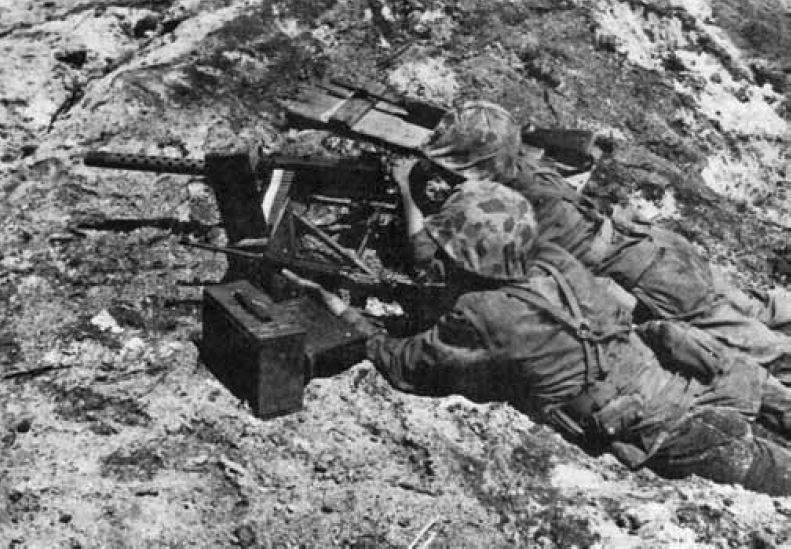
Two U.S. Marines with a M1919A4 machine gun on Roi-Namur Island in the Marshall Islands during World War II. [Wikimedia]

It appears that discussion of the meaning of lethality, as related to the use of the term in the 2018 U.S. National Defense Strategy document, has sparked up again. It was kicked off by an interesting piece by Olivia Gerard in The Strategy Bridge last autumn, “Lethality: An Inquiry.

Gerard credited Trevor Dupuy and his colleagues at the Historical Evaluation Research Organization (HERO) with codifying “the military appropriation of the concept” of lethality, which was defined as: “the inherent capability of a given weapon to kill personnel or make materiel ineffective in a given period, where capability includes the factors of weapon range, rate of fire, accuracy, radius of effects, and battlefield mobility.”

It is gratifying for Gerard to attribute this to Dupuy and HERO, but some clarification is needed. The definition she quoted was, in fact, one provided to HERO for the purposes of a study sponsored by the Advanced Tactics Project (AVTAC) of the U.S. Army Combat Developments Command. The 1964 study report, Historical Trends Related to Weapon Lethality, provided the starting point for Dupuy’s subsequent theorizing about combat.

In his own works, Dupuy used a simpler definition of lethality:

He also used the terms lethality and firepower interchangeably in his writings. The wording of the original 1964 AVTAC definition tracks closely with the lethality scoring methodology Dupuy and his HERO colleagues developed for the study, known as the Theoretical Lethality Index/Operational Lethality Index (TLI/OLI). The original purpose of this construct was to permit some measurement of lethality by which weapons could be compared to each other (TLI), and to each other through history (OLI). It worked well enough that he incorporated it into his combat models, the Quantified Judgement Model (QJM) and Tactical Numerical Deterministic Model (TNDM).

Some Background on Lethality

There have recently been some articles and talk about lethality. This is hardly a new subject, although apparently there is some renewed interest in the subject. More to the point, the word is now being used extensively in discussions, even though I do not fully understand what they mean by it. This article in late 2018 from The Strategy Bridge provides a little background on the subject: https://thestrategybridge.org/the-bridge/2018/11/1/lethality-an-inquiry

As the article states (bolding is mine):

 Left undefined, lethality risks the fate of many insufficiently elucidated but well-meaning concepts. It is imperative the concept is properly understood, otherwise the word will saturate PowerPoint slides bereft of insight.

And then there is the sentence further on that catches my attention:

Trevor Dupuy’s 1964 “Final Report on Historical Trends Related to Weapon Lethality” codified the military appropriation of the concept. 

OK, so we are (were) at the cutting edge (in 1964). Nice to know. This was news to me. I had been ignoring all this discussion on lethality until more than one person brought it to my attention this last week. Trevor Dupuy later used this report for his book Evolution of Weapons and Warfare.

Anyhow, I guess we should start blogging about lethality a little more, even though I am not sure what all is encompassed by other people’s use of the word.