Category Eastern Front

You might want to pre-order the book

By the way, if you pre-order The Battle of Prokhorovka through amazon.com it is selling for $28.43: Buy from Amazon The list price on the hardcover is  $44.95. I do not know what price it will be listed at on 1 June 2019 (nor do I have any involvement or say in these matters).

The book can obtained from Stackpole at: Stackpole Books

Or from Amazon.com at: Buy from Amazon

The Battle of Prokhorovka book — why?

My original contract back in 1999 to prepare the Kursk book was for a single book of 450 pages. During the writing process….the book grew. This is discussed in this article: http://www.aberdeenbookstore.com/the-largest-history-book-ever

When I realized how large the book was, I contacted the publisher and discussed the issue with him. I suggested that we go ahead and complete the large book I was writing and then go back and do an abridged version. He graciously agreed, but unfortunately I was unable to complete the original book in 2003/2004 (although it was mostly done) due to my work at The Dupuy Institute, magnified by a war or two going on.

So, when I was finally able to get back to this book (thanks to government budget cuts and sequestration), I was left with an original book of 1,662 pages. Clearly there was a need for a smaller book.

This is not that book. This book is the updated chapters of the original book that focus on the fighting by the SS Panzer Corps, III Panzer Corps, parts of the Sixth Guards Army, Sixty-Ninth Army, Fifth Guards Army, Fifth Guard Tank Army and parts of the Seventh Guards Army from 9 to 17 July 1943. As such, it is 40% of the original book sectioned off as a separate stand alone book.

I could do four such books from my original book. This is the first of these books. I am currently finishing up a second such book (Aces at Kursk: The Belgorod Offensive Air War). I could do two more books along that line (Battle of Tolstoye Woods and The Belgorod Offensive), although I am not sure that I ever will. It depends on demand, sales, the publisher’s interest, my time, and my mood.

I may also get around to writing a single 300-page book summarizing the offensive in the south. We shall see. There are a lot of other projects I am also considering.

The book can obtained from Stackpole at: Stackpole Books

Or from Amazon.com at: Buy from Amazon

The Battle of Prokhorovka — what does the book consist of

The book consists of:

  1. 638 numbered pages (and 14 pages of front matter)
  2. 75 Listed illustrations and maps
  3. Four photo sections
    1. 15 terrain photos
    2. 12 recon photos
    3. 64 battlefield photos
    4. 70 commander photos
  4. One map section with 17 maps
  5. 18 numbered tables
  6. 21 graphs
  7. 44 sidebars
  8. 76 engagement sheets

Just for the record, my original mega-book consisted of 192 engagement sheets. So one could make the argument that this book covers 40% of the Belgorod offensive (at least compared to the original book).

The book was edited by the same editor of the original book, Ariane Smith of Capital A: http://www.capitala.net/. Therefore, it is of a very similar format and style.

The book can obtained from Stackpole at: Stackpole Books

Or from Amazon.com at: Buy from Amazon

The Battle of Prokhorovka – 16 chapters

My new book The Battle of Prokhorovka consists of 16 chapters (the original mega-book had 27). The chapters are:

1. Preparing for the Showdown…..page 13
2. The Soviets Prepare…..page 35
3. The Belgorod Offensive: 4-8 July 1943…..page 51
4. The XLVIII Panzer Corps Heads West: 9 – 11 July 1943…..page 113
5. The Advance on Prokhorovka: 9-11 July…..page 133
6. The Advance on the Severnyii Donets: 9-11 July 1943…..page 203
7. The Situation as of 11 July 1943…..page 229
8. The Air War: 9-18 July 1943…..page 243
9. The Tank Fields of Prokhorovka, 12 July 1943…..page 291
10. SS Panzer Corps Attack Stalls, 13 July 1943…..page 359
11. Soviet Counterattacks against the III Panzer Corps: 12-13 July 1943…..page 375
12. Aftermath of Prokhorovka: 13 July 1943…..page 401
13. Cleaning Up the Donets Triangle: 14-15 July 1943…..page 475
14. The Battlefield is Quiet: 16-17 July 1943…..page 511
15. The German Withdrawal: 18-24 July 1943…..page 539
16. Post-Mortem…..page 559

There are only two short appendices in this book (the original book had 7 appendices totaling 342 pages):

Appendix I: German and Soviet Terminology…..page 615
Appendix II: The Engagements…..page 623

The book can obtained from Stackpole at: Stackpole Books

Or from Amazon.com at: Buy from Amazon

Validation Data Bases Available (Kursk)

The second large campaign validation database created was the Kursk Data Base (KDB), done 1993-1996. I was also the program manager for this one and it ran a lot smoother than the first database. There was something learned in the process. This database involved about a dozen people, including a Russian research team led by Col. (Dr.) Fyodor Sverdlov, WWII veteran, author and Frunze Military academy; and ably assisted by Col. (Dr.) Anatoli Vainer, ditto. It also involved was the author Dr. Richard Harrison, and of course, Richard Anderson and Jay Karamales. Col. David Glantz helped with the initial order of battle as a consultant.

The unique aspect of the database is that we obtained access to the Soviet archives and was able to pull from it the unit records at the division, corps and army-level for every Soviet unit involved. This was a degree of access and research never done before for an Eastern Front battle. We were not able to access the Voronezh Front files and other higher command files as they were still classified.

The KDB tracked the actions of all divisions and division-sized units on both sides for every day of the German offensive in the south for 4 July 1943 to 18 July 1943. Kursk is a huge battle (largest battle of WWII) and consists of four separate portions. This database covered only one of the four parts, and that part was similar in size to the Battle of the Bulge and the air battle was larger than the Battle of Britain. On the German side were 17 panzer, panzer grenadier and infantry divisions while on the Soviet side were 37 rifle divisions and 10 tank and mechanized corps. There were 9 attacking German armored divisions versus 10 Soviet tank and mechanized corps at the Belgorod Offensive at Kursk. At the Battle of the Bulge there were 8 attacking (engaged) German armored divisions versus 9 U.S. armored divisions. The database design and what data was tracked was almost the same as the Ardennes Campaign Simulation Data Base (ACSDB). The stats on the data are here: http://www.dupuyinstitute.org/data/kursk.htm

The database was programmed in Dbase IV and is DOS based. Dbase IV has the advantage that it allowed text fields. Dbase III did not, so we were limited to something like 256 characters for our remarks fields. With Dbase IV, the remarks fields sometimes grew to a page or two as we explained what data was available and how they were used to assemble daily counts of strengths and losses. Sometimes they were periodic (vice daily) reports and sometimes contradictory reports. It was nice to be able to fully explain for each and every case how we analyzed the data. The Dbase IV version of the KDB is publicly available through NTIS (National  Technical Information Service). The pictures in this blog post are screen shots from the Dbase IV version.

We also re-programmed the data base into Access and rather extensively and systematically updated it. This was in part because we took every single unit for every single day of the battle and assembled it into 192 different division-on-division engagements for use in our Division Level Engagement Data Base (DLEDB). This was done over a period of 11 years. We did the first 49 engagements in 1998-99 to support the Enemy Prisoner of War (EPW) Capture Rate Study for CAA (Center for Army Analysis), report E-4 (see http://www.dupuyinstitute.org/tdipub3.htm). Some of the other engagements were done later to support the study on Measuring the Value of Situational Awareness for OSD Net Assessment (Andy Marshall’s shop), reports SA-1. We (meaning me) then finished up the rest of the engagements in 2004 and 2009. In the end we had assembled an engagement record for every single division-on-division level engagement for the Belgorod Offensive. Added to that, in 1999 I began working on my Kursk book, which I had mostly finished in 2003 (but was not published until 2015). So over time, we rather systematically reviewed and revised the data in the database. This is not something we were able to do to the same extent for the ACSDB. The 192 engagements in DLEDB were then summarized as 192 separate “engagement sheets” in my Kursk book. There are also 76 of these engagement sheets available in my new Kursk book coming out in June: The Battle of Prokhorovka. This new book covers the part of the Belgorod offensive centered around the Battle of Prokhorovka.

TDI Friday Read: Tank Combat at Kursk

Today’s edition of TDI Friday Read is a roundup of posts by TDI President Christopher Lawrence exploring the details of tank combat between German and Soviet forces at the Battle of Kursk in 1943. The prevailing historical interpretation of Kursk is of the Soviets using their material and manpower superiority to blunt and then overwhelm the German offensive. This view is often buttressed by looking at the  ratio of the numbers of tanks destroyed in combat. Chris takes a deeper look at the data, the differences in the ways “destroyed” tanks were counted and reported, and the differing philosophies between the German and Soviet armies regarding damaged tank recovery and repair. This yields a much more nuanced perspective on the character of tank combat at Kursk that does not necessarily align with the prevailing historical interpretations. Historians often discount detailed observational data on combat as irrelevant or too difficult to collect and interpret. We at TDI believe that with history, the devil is always in the details.

Armor Exchange Ratios at Kursk

Armor Exchange Ratios at Kursk, 5 and 6 July 1943

Soviet Tank Repairs at Kursk (part 1 of 2)

Soviet Tank Repairs at Kursk (part 2 of 2)

German Damaged versus Destroyed Tanks at Kursk

Soviet Damaged versus Destroyed Tanks at Kursk

Comparative Tank Exchange Ratios at Kursk

Hausser Wielding Chalk

The Battle of Prokhorovka took place on 12 July 1943 (and for several days after, depending on definition). The most famous part of the fighting was the attack from the Soviet XVIII Tank Corps and XXIX Tank Corps against the Leibstandarte SS Adolf Hitler Division.

Several stories posted on the web and I gather a few books mention something like: “Several German accounts mention that SS-Obergruppenführer Paul Hausser, commander of the SS Panzer Corps, had to use chalk to mark and count the huge jumble of 93 knocked-out Soviet tanks in the Leibstandarte sector alone.”

Now, this makes for an interesting scene: General Hausser, the 62-year old founder of the Waffen SS, is crawling around the battlefield marking up 93 tanks with chalk. With the Totenkopf SS Division having to continue the offensive on the 13th, and Das Reich SS Division in the days after that, I would think that the SS Panzer Corps commander would have a few more important things to do at this moment. Also suspect that significant parts of the battlefield were still under enemy observation. Its gets a little hard to imagine that Hausser was out there with chalk counting tanks.

Does anyone know the original source of this story?

T-34s on 5 July 1943

The biggest problem with the kill claims related to the Leibstandarte SS Adolf Hitler (LSSAH) Division’s Tiger company on 5 July 1943 is that they claim dozens of T-34s killed on the 5th of July, when there were few in the area.

These specific claims are discussed here:

Panzer Aces Wittmann and Staudegger at Kursk – part 1

There were no units armed with T-34s that were attached to the Sixth Guards Army, and the armored units in the area with T-34s were not in action for most of the 5th (this would include the III Mechanized Corps and the II Guards Tank Corps).  So either the LSSAH Tigers shot up a lot of M-3 Lees and Stuarts and they have become T-34s in the retelling, or the claims are just grossly inflated or flat out wrong.

But….there may have been a few T-34s in the area. According to the March-April 1944 Soviet General Staff Study done on Kursk, 10 or 15 tanks were deployed in the fortified areas as part of the defense. See page 284 of my Kursk book. But, in the unit records we had, we never had a report on them (including in the Sixth Guards Army records). We have not seen any record of them other than the single report in the General Staff Study.

So there were 10 or 15 tanks deployed in the fortified areas. They do not say where and what types of tanks. It could have been T-34s in the Sixth Guards Army area….or it could not be. They could have been deployed together or scattered.

There are a few reports of dug-in T-34s on 4 and 5 July 1943.

Guenther Baer, II Battalion of the LSSAH Tank Regiment, reports for the 4th of July, the pre-battle evening clearing attack on the Soviet outpost line that:

We also came upon scattered dug-in T-34s, who were then quickly disabled by our own tanks. (page 282…interview was done in 1999 by MG Dieter Brand).

Lt. Franz-Joachim von Rodde, an adjutant with the 6th Panzer Regiment, 3rd Panzer Division reports that:

That evening [5 July]…penetrated all the way to a small village [Krasnyii Pochinok] along a narrow front line and staggered towards the rear. The village itself could not be taken in time, though. Here we encountered T-34s dug-in up to their turrets for the first time. (page 367…interview was done in 1999 by MG Dieter Brand).

As I note on page 368:

Lt. Rodde’s memory of T-34s dug-in around Krasnyii Pochinok cannot be confirmed. The Soviet 245th Tank Regiment did not have T-34s. The nearest forces with T-34s would be the 59th and 60th Tank Regiment attached to the Fortieth Army. While these forces may well have been in the area (as this is not the only report of tanks we have on the front line of the 71st Guard Rifle Division, 67th Guards Rifle Division, or the Fortieth Army units), we have not accounts of them being there in the Soviet records.

Just to continue Rodde’s quote:

This was another measure hitherto unknown. These dug-in tanks were very dangerous. They were camouflaged extremely well–as usual with the Russians–and could only be reconnoitered once they opened fire. They usually fired at short range so as to have a maximum chance of hitting something.

Then there also the reports of dug-in tanks from Alfred Rubbel, 503rd Heavy Panzer (Tiger) Battalion, in the area where the 6th Panzer Division was attacking on the 5th, but this is out of the area of our concern (see page 403). Still just to quote:

Our Tiger company suffered the first losses as well. For the first time we saw dug-in enemy tanks in this sector. In a way this was a surprise as that was a use of tanks not at all typical. There dug-in tanks were firing with great precision from their position and were thus very dangerous for us. On that day alone, we have four losses due to enemy fire, which could all be recovered but nevertheless represented the highest number of losses in one day of battle we had to absorb during the entire operation.

Those tanks were most likely from the Soviet 262nd Tank Regiment, which started the battle with 22 KV-1s.

So we have reports of dug-in T-34s in front of the LSSAH Division and in front of 3rd Panzer Division. These are two widely separated locations. So it is distinctly possible that the SS Panzer Corps could have encountered 6-9 dug-in T-34s. This is still considerably less than what they claim, but probably there is some basis to their claims. Still, it would appear that they, or subsequent authors, either over-claimed or credited every tanks as destroyed as being a T-34, even though most were not.

Hard to sort it out 75 years after the fact…..but it is clear that many of the published claims for 5 July 1943 are not correct.

Quantifying the Holocaust

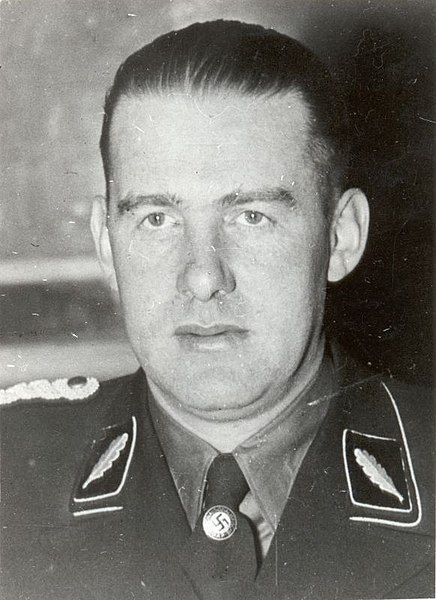
Odilo Globocnik, SS and Police Leader in the Lublin district of the General Government territory in German-occupied Poland, was placed in charge of Operation Reinhardt by SS Reichsführer Heinrich Himmler. [Wikipedia]

The devastation and horror of the Holocaust makes it difficult to truly wrap one’s head around its immense scale. Six million murdered Jews is a number so large that it is hard to comprehend, much less understand in detail. While there are many accounts of individual experiences, the wholesale destruction of the Nazi German documentation of their genocide has made it difficult to gauge the dynamics of their activities.

However, in a new study, Lewi Stone, Professor of Biomathematics at RMIT University in Australia, has used an obscure railroad dataset to reconstruct the size and scale of a specific action by the Germans in eastern Poland and western Ukraine in 1942. “Quantifying the Holocaust: Hyperintense kill rates during the Nazi genocide,” (Not paywalled. Yet.) published on 2 January in the journal Science Advances, uses train schedule data published in 1987 by historian Yitzhak Arad to track the geographical and temporal dimensions of some 1.7 Jews transported to the Treblinka, Belzec and Sobibor death camps in the late summer and early autumn of 1942.

This action, known as Operation Reinhardt, originated during the Wansee Conference in January 1942 as the plan to carry out Hitler’s Final Solution to exterminate Europe’s Jews. In July, Hitler “ordered all action speeded up” which led to a frenzy of roundups by SS (Schutzstaffel) groups from over 400 Jewish communities in Poland and Ukraine, and transport via 500 trains to the three camps along the Polish-Soviet border. In just 100 days, 1.7 million people had been relocated and almost 1.5 million of them were murdered (“special treatment” (Sonderbehandlung)), most upon arrival at the camps. This phase of Reinhardt came to an end in November 1942 because the Nazis had run out of people to kill.

This three-month period was by far the most intensely murderous phase of the Holocaust, carried out simultaneously with the German summer military offensive that culminated in disastrous battlefield defeat at the hands of the Soviets at Stalingrad at year’s end. 500,000 Jews were killed per month, or an average of 15,000 per day. Even parsed from the overall totals, these numbers remain hard to grasp.

Stone’s research is innovative and sobering. His article can currently be downloaded in PDF format. His piece in The Conversation includes interactive online charts. He also produced a video the presents his findings chronologically and spatially: