Category World War II

Artillery Effectiveness vs. Armor (Part 5-Summary)

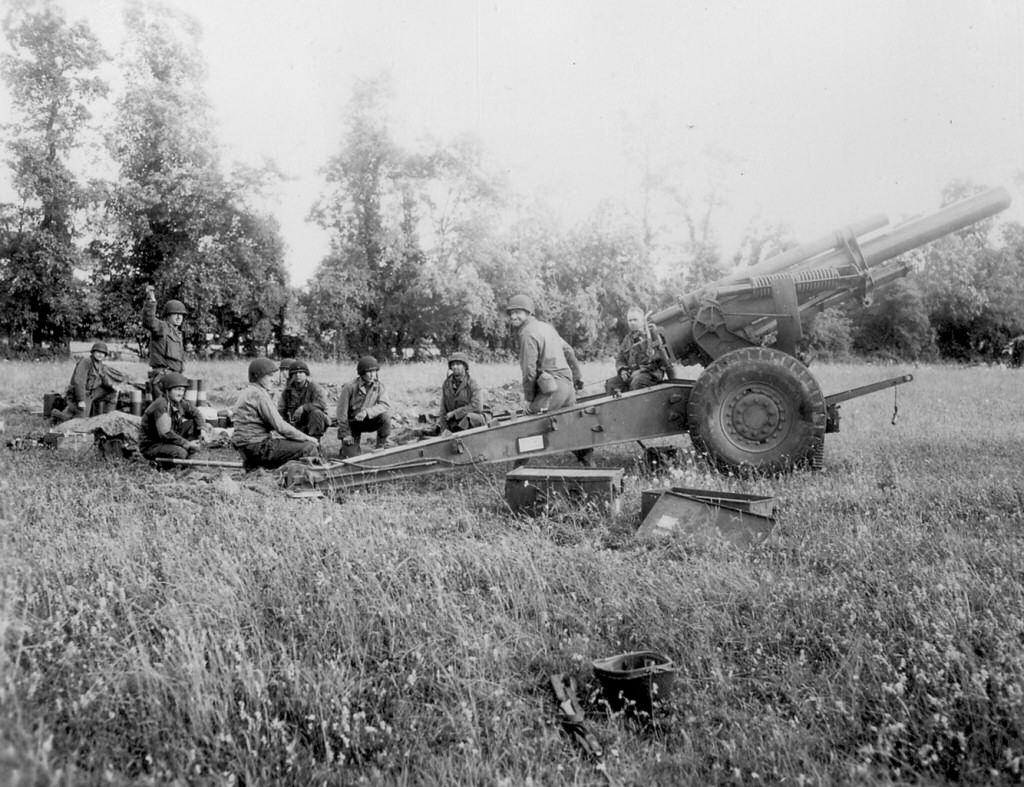
U.S. Army 155mm field howitzer in Normandy. [padresteve.com]

[This series of posts is adapted from the article “Artillery Effectiveness vs. Armor,” by Richard C. Anderson, Jr., originally published in the June 1997 edition of the International TNDM Newsletter.]

Posts in the series
Artillery Effectiveness vs. Armor (Part 1)
Artillery Effectiveness vs. Armor (Part 2-Kursk)
Artillery Effectiveness vs. Armor (Part 3-Normandy)
Artillery Effectiveness vs. Armor (Part 4-Ardennes)
Artillery Effectiveness vs. Armor (Part 5-Summary)

Table IX shows the distribution of cause of loss by type or armor vehicle. From the distribution it might be inferred that better protected armored vehicles may be less vulnerable to artillery attack. Nevertheless, the heavily armored vehicles still suffered a minimum loss of 5.6 percent due to artillery. Unfortunately the sample size for heavy tanks was very small, 18 of 980 cases or only 1.8 percent of the total.

The data are limited at this time to the seven cases.[6] Further research is necessary to expand the data sample so as to permit proper statistical analysis of the effectiveness of artillery versus tanks.

NOTES

[18] Heavy armor includes the KV-1, KV-2, Tiger, and Tiger II.

[19] Medium armor includes the T-34, Grant, Panther, and Panzer IV.

[20] Light armor includes the T-60, T-70. Stuart, armored cars, and armored personnel carriers.

Artillery Effectiveness vs. Armor (Part 4-Ardennes)

Knocked-out Panthers in Krinkelt, Belgium, Battle of the Bulge, 17 December 1944. [worldwarphotos.info]

[This series of posts is adapted from the article “Artillery Effectiveness vs. Armor,” by Richard C. Anderson, Jr., originally published in the June 1997 edition of the International TNDM Newsletter.]

Posts in the series
Artillery Effectiveness vs. Armor (Part 1)
Artillery Effectiveness vs. Armor (Part 2-Kursk)
Artillery Effectiveness vs. Armor (Part 3-Normandy)
Artillery Effectiveness vs. Armor (Part 4-Ardennes)
Artillery Effectiveness vs. Armor (Part 5-Summary)

NOTES

[14] From ORS Joint Report No. 1. A total of an estimated 300 German armor vehicles were found following the battle.

[15] Data from 38th Infantry After Action Report (including “Sketch showing enemy vehicles destroyed by 38th Inf Regt. and attached units 17-20 Dec. 1944″), from 12th SS PzD strength report dated 8 December 1944, and from strengths indicated on the OKW briefing maps for 17 December (1st [circa 0600 hours], 2d [circa 1200 hours], and 3d [circa 1800 hours] situation), 18 December (1st and 2d situation), 19 December (2d situation), 20 December (3d situation), and 21 December (2d and 3d situation).

[16] Losses include confirmed and probable losses.

[17] Data from Combat Interview “26th Infantry Regiment at Dom Bütgenbach” and from 12th SS PzD, ibid.

Artillery Effectiveness vs. Armor (Part 3-Normandy)

The U.S. Army 333rd Field Artillery Battalion (Colored) in Normandy, July 1944 (US Army Photo/Tom Gregg)

[This series of posts is adapted from the article “Artillery Effectiveness vs. Armor,” by Richard C. Anderson, Jr., originally published in the June 1997 edition of the International TNDM Newsletter.]

Posts in the series
Artillery Effectiveness vs. Armor (Part 1)
Artillery Effectiveness vs. Armor (Part 2-Kursk)
Artillery Effectiveness vs. Armor (Part 3-Normandy)
Artillery Effectiveness vs. Armor (Part 4-Ardennes)
Artillery Effectiveness vs. Armor (Part 5-Summary)

NOTES

[10] From ORS Report No. 17.

[11] Five of the 13 counted as unknown were penetrated by both armor piercing shot and by infantry hollow charge weapons. There was no evidence to indicate which was the original cause of the loss.

[12] From ORS Report No. 17

[13] From ORS Report No. 15. The “Pocket” was the area west of the line Falaise-Argentan and east of the line Vassy-Gets-Domfront in Normandy that was the site in August 1944 of the beginning of the German retreat from France. The German forces were being enveloped from the north and south by Allied ground forces and were under constant, heavy air attack.

Artillery Effectiveness vs. Armor (Part 2-Kursk)

15 cm schwere Feldhaubitze 18 (15 cm s.FH 18 L/29,5)

German Army 150mm heavy field howitzer 18 L/29.5 battery. [Panzer DB/Pinterest]

[This series of posts is adapted from the article “Artillery Effectiveness vs. Armor,” by Richard C. Anderson, Jr., originally published in the June 1997 edition of the International TNDM Newsletter.]

Posts in the series
Artillery Effectiveness vs. Armor (Part 1)
Artillery Effectiveness vs. Armor (Part 2-Kursk)
Artillery Effectiveness vs. Armor (Part 3-Normandy)
Artillery Effectiveness vs. Armor (Part 4-Ardennes)
Artillery Effectiveness vs. Armor (Part 5-Summary)

Curiously, at Kursk, in the case where the highest percent loss was recorded, the German forces opposing the Soviet 1st Tank Army—mainly the XLVIII Panzer Corps of the Fourth Panzer Army—were supported by proportionately fewer artillery pieces (approximately 56 guns and rocket launchers per division) than the US 1st Infantry Division at Dom Bütgenbach (the equivalent of approximately 106 guns per division)[4]. Nor does it appear that the German rate of fire at Kursk was significantly higher than that of the American artillery at Dom Bütgenbach. On 20 July at Kursk, the 150mm howitzers of the 11th Panzer Division achieved a peak rate of fire of 87.21 rounds per gum. On 21 December at Dom Bütgenbach, the 155mm howitzers of the 955th Field Artillery Battalion achieved a peak rate of fire of 171.17 rounds per gun.[5]

NOTES

[4] The US artillery at Dom Bütgenbach peaked on 21 December 1944 when a total of 210 divisional and corps pieces fired over 10,000 rounds in support of the 1st Division’s 26th Infantry.

[5] Data collected on German rates of fire are fragmentary, but appear to be similar to that of the American Army in World War ll. An article on artillery rates of fire that explores the data in more detail will be forthcoming in a future issue of this newsletter. [NOTE: This article was not completed or published.]

Notes to Table I.

[8] The data were found in reports of the 1st Tank Army (Fond 299, Opis‘ 3070, Delo 226). Obvious math errors in the original document have been corrected (the total lost column did not always agree with the totals by cause). The total participated column evidently reflected the starting strength of the unit, plus replacement vehicles. “Burned'” in Soviet wartime documents usually indicated a total loss, however it appears that in this case “burned” denoted vehicles totally lost due to direct fire antitank weapons. “Breakdown” apparently included both mechanical breakdown and repairable combat damage.

[9] Note that the brigade report (Fond 3304, Opis‘ 1, Delo 24) contradicts the army report. The brigade reported that a total of 28 T-34s were lost (9 to aircraft and 19 to “artillery”) and one T-60 was destroyed by a mine. However, this report was made on 11 July, during the battle, and may not have been as precise as the later report recorded by 1st Tank Army. Furthermore, it is not as clear in the brigade report that “artillery” referred only to indirect fire HE and not simply lo both direct and indirect fire guns.

Artillery Effectiveness vs. Armor (Part 1)

A U.S. M1 155mm towed artillery piece being set up for firing during the Battle of the Bulge, December 1944.

[This series of posts is adapted from the article “Artillery Effectiveness vs. Armor,” by Richard C. Anderson, Jr., originally published in the June 1997 edition of the International TNDM Newsletter.]

Posts in the series
Artillery Effectiveness vs. Armor (Part 1)
Artillery Effectiveness vs. Armor (Part 2-Kursk)
Artillery Effectiveness vs. Armor (Part 3-Normandy)
Artillery Effectiveness vs. Armor (Part 4-Ardennes)
Artillery Effectiveness vs. Armor (Part 5-Summary)

The effectiveness of artillery against exposed personnel and other “soft” targets has long been accepted. Fragments and blast are deadly to those unfortunate enough to not be under cover. What has also long been accepted is the relative—if not total—immunity of armored vehicles when exposed to shell fire. In a recent memorandum, the United States Army Armor School disputed the results of tests of artillery versus tanks by stating, “…the Armor School nonconcurred with the Artillery School regarding the suppressive effects of artillery…the M-1 main battle tank cannot be destroyed by artillery…”

This statement may in fact be true,[1] if the advancement of armored vehicle design has greatly exceeded the advancement of artillery weapon design in the last fifty years. [Original emphasis] However, if the statement is not true, then recent research by TDI[2] into the effectiveness of artillery shell fire versus tanks in World War II may be illuminating.

The TDI search found that an average of 12.8 percent of tank and other armored vehicle losses[3] were due to artillery fire in seven eases in World War II where the cause of loss could be reliably identified. The highest percent loss due to artillery was found to be 14.8 percent in the case of the Soviet 1st Tank Army at Kursk (Table II). The lowest percent loss due to artillery was found to be 5.9 percent in the case of Dom Bütgenbach (Table VIII).

The seven cases are split almost evenly between those that show armor losses to a defender and those that show losses to an attacker. The first four cases (Kursk, Normandy l. Normandy ll, and the “Pocket“) are engagements in which the side for which armor losses were recorded was on the defensive. The last three cases (Ardennes, Krinkelt. and Dom Bütgenbach) are engagements in which the side for which armor losses were recorded was on the offensive.

Four of the seven eases (Normandy I, Normandy ll, the “Pocket,” and Ardennes) represent data collected by operations research personnel utilizing rigid criteria for the identification of the cause of loss. Specific causes of loss were only given when the primary destructive agent could be clearly identified. The other three cases (Kursk, Krinkelt, and Dom Bütgenbach) are based upon combat reports that—of necessity—represent less precise data collection efforts.

However, the similarity in results remains striking. The largest identifiable cause of tank loss found in the data was, predictably, high-velocity armor piercing (AP) antitank rounds. AP rounds were found to be the cause of 68.7 percent of all losses. Artillery was second, responsible for 12.8 percent of all losses. Air attack as a cause was third, accounting for 7.4 percent of the total lost. Unknown causes, which included losses due to hits from multiple weapon types as well as unidentified weapons, inflicted 6.3% of the losses and ranked fourth. Other causes, which included infantry antitank weapons and mines, were responsible for 4.8% of the losses and ranked fifth.

NOTES

[1] The statement may be true, although it has an “unsinkable Titanic,” ring to it. It is much more likely that this statement is a hypothesis, rather than a truism.

[2] As pan of this article a survey of the Research Analysis Corporation’s publications list was made in an attempt to locate data from previous operations research on the subject. A single reference to the study of tank losses was found. Group 1 Alvin D. Coox and L. Van Loan Naisawald, Survey of Allied Tank Casualties in World War II, CONFIDENTIAL ORO Report T-117, 1 March 1951.

[3] The percentage loss by cause excludes vehicles lost due to mechanical breakdown or abandonment. lf these were included, they would account for 29.2 percent of the total lost. However, 271 of the 404 (67.1%) abandoned were lost in just two of the cases. These two cases (Normandy ll and the Falaise Pocket) cover the period in the Normandy Campaign when the Allies broke through the German defenses and began the pursuit across France.

6th Panzer Division Tank Losses on 9 July 1943

There are some questions about the loss figures for the 6th Panzer Division on the 9th of July 1943. This is in response to this post:

Obscure Major Tank Battle on 9 July 1943

In my book (page 767) I state that the 6th Panzer Division lost 38 tanks this day. Let us look where those figures came from.

In the Provisional Army Kempf files is a report of “The Tank Situation on 9 July early [morning]. It is file T312, R58, page 4374. They report for the 6th Panzer Division

                            Ready for Action             Lost on 8.7.43

Pz II                         7                                     1

Pz III short              —

Pz III long              24

Pz III 75                 12                                     1

Pz IV short              —

Pz IV long              14

Command                3

Flame                    10

VI                            —

Assault Gun            —

Total                       70                                     2

The next page of the report for 10 July (again “early” as in früh, which I gather means “early” or “early in the morning”).

                           Ready for Action             Lost on 9.7.43

Pz II                         0?

Pz III short              —

Pz III long              12

Pz III 75                   1

Pz IV short              —

Pz IV long                7

Command                2

Flame                     —

VI                             —

Assault Gun            —

Total                       22

There is no report on losses for the 9th for the 6th PzD but there are for the other units (including the 19 Tigers lost by the 503rd Heavy Tank Battalion).

So….70 – 22 = 48. Now 5 of the 10 flamepanzers were detached to the 19th Panzer Division, so not sure of their status. If I subtract them out, I end up with 38 tanks lost.

As the first report is early on the 9th and the next report is early on the 10th, then I can only assume that most, if not all losses, were suffered on the 9th.

There was a book page that was copied by one commentator

You will note that it shows 70 tanks on 9 July (9Julam) and 22 tanks of 10 July (10 Julam). I am guessing that “9Julam” means morning of 9 July. If so, this chart appears to have been created from the same data I have and indicates up to 48 losses on 9 July.

Is this issue settled? There are similar reports for the rest of the armor units in Provisional Army Kempf.

Obscure Major Tank Battle on 9 July 1943

There is an extended discussion in my Kursk book called “The Reinforced 6th Panzer Division Crashes Forward” on pages 766-768.

There was a significant fight around the towns of Melikhovo and Shlyakhovoye in the III Panzer Corps sector on 9 July. The 6th Panzer Division had attached to it the panzer regiment from the 19th Panzer Division, the 503rd Heavy Panzer Battalion (Tiger) and the 228th Assault Gun Battalion.The Soviet defenders included the 305th Infantry Division, 92nd Guards Rifle Division and 96th Tank Brigade.

To quote:

This fighting must have been extremely deadly for the 6th Panzer Division, for it appears to have lost 38 of 73 tanks this day…The attached Tiger Battalion fared no better, with a loss of 19 of 33 tanks….The 228th Assault Gun Battalion was clearly in the middle of the fight also, indicating a loss of 12 Sturmgeschuetz IIIs of 23. The Panzer Group Westhoven, attached from the 19th Panzer Division, would also fair poorly, losing 30 tanks this day. This was a devastating loss of almost 100 tanks in one day!…

The unheralded day of fighting appears to have cost the III Panzer corps over 100 tanks and assault guns. This was not only the worst day of combat for the corps, but one of the worst for the Germans in the attack in the south….

To put this in perspective, the SS Panzer Corps’ worst day had been fewer than 80 tanks lost (on the 6th)…..Even at the famed Battle of Prokhorovka on the 12th of July, the SS Panzer Corps lost fewer tanks. While Rotmistrov and the Fifth Guards Tank Army became renown for this action, the fighting today (9 July) between Andreyevskiye and Melikhovo was truly unheralded, yet not mentioned in major histories of the battles and the Soviet defenders have not been singled out. 

A few photos of the area:

The first is of the area northeast of Belgorod, showing where the Lipovyii and Severnyii Donets meet, 2 June 1943. The railroad on the left (west) goes to Prokhorovka. The two large villages in the south are Staryii Gorod and Blizhnyaya Igumenka while the three lrager villages in the north are Belomestnaya, Petrpavllovka, and Dalnayaya Igumenka  (see page 580). The small town of Andreyevskiye is on the river just to the north-northeast (1 km) of Blizhnyaya Igumenka. It is in the river just west of the woods north of Blizhnyaya Igumenka (the woods almost in the center of the map). Melikhovo is 4+ km to the northeast of the those woods. It is in the northeast corner of the picture, but hard to see in the darkened section. Shlyakhovoye is just beyond it.

Next is Stayii Gorod, 3 July 1943. Note the trench works in the while area and elsewhere (see page 572).

Finally there is the close-up photo of the woods just south of Blizhnyaya Igumenka and east of Staryii Gorod, 7 July 1943. Note the trenchworks. This would be a second echelon defensive position. The same woods is visible in the previous photo east of Staryii Gorod (see page 573).


I have four engagement sheets covering the operation of the III Panzer Corps for this day (pages 770-773):

German        German        Soviet         German      Soviet    German       Soviet

Unit               Strength       Strength     Armor         Armor     Artillery       Artillery

168th ID          8,077           9,342          6                 0             48             111

19th PzD       19,347        10,179         13                0              161           107

6th PzD         22,792        16,241        158               54            143           151

7th PzD         19,355        19,658          52               28            127           171

Total              69,571        55,420        229               82            479           540


German        German        Soviet          German         Soviet

Unit               Casualties    Casualties  Tank Losses   Tank Losses

168th ID          98                 193                0                      0

19th PzD        472                935                6                      0

6th PzD          177             1,476               97                   13

7th PzD          367                270                 5                     0

Total            1,114             2,874             108                   13


This was very heavy tank losses for a single day of combat, yet there is no one who discusses it. Is there something about this day that I have mis-interpreted?

Panzer Battalions in LSSAH in July 1943

I was recently reviewing a book called Germany and the Second World War: The Eastern Front 1943-1944. On page 124 it stated that “[On 12 July] In reality, this [the Adolf Hitler SS Panzer] regiment consisted of only one battalion of three companies, to which a heavy armoured company with four operational Tigers had been attached. The other battalion was back in Germany undergoing conversion to Panthers.”

Now, the LSSAH (Leibstandarte SS Adolf Hitler) Division did send its I Battalion back to convert to Panthers, but I still believe that the tank (panzer) regiment was operating with two battalions and more than three regular panzer companies. They probably had a temporary battalion drawn from elsewhere as had been done for the Das Reich SS Division. The problem is that I do not have a detailed organization chart for the LSSAH Division for June or July 1943. I do have the Das Reich and Totenkopf organization charts for August and July respectively and they both have two battalions with 7 or 8 panzer companies. As the Adolf Hitler SS Division has more tanks than either of them, I assume it also had two panzer battalions. Yet other authors seem to want to imply that somehow the Adolf Hitler SS Panzer Regiment was at half-strength at Prokhorovka, even though it had more tanks than either of the other two SS divisions..

On page 136 of that book it states that “The conclusion is that on 12 July at Prokhorovka 5th Guards Armoured Army fought only against two SS Armoured Infantry Divisions (each with a single armoured battalion), apart from an insignificant skirmish at Rzhavets.”

To start with the LSSAH Division on 4 July had 90 Pz III and IVs, and 9 Pz III Command tanks. There is simply no way to assemble them into a battalion of three companies with a strength of only 22 tanks per company. Even if 5 Pz IIIs are with the 13th Panzer Company (the Tiger company), and another 9 – 13 tanks are with the battalion and regiment headquarters, this leaves at least 81 Pz III and IVs for the II Battalion. With only three companies, they were either operating with 27 or more tanks per company, or there was some other organization. Ribbentrop, the 6th company commander, did state that there were 22 tanks in his company and I don’t recall seeing overstrength tank companies in German organizations before.

So, either the LSSAH had 1) overstrength tank companies, 2) a 4th company in the II Battalion, or 3) a temporary I Battalion.

I do not have an organization chart of LSSAH for June, July or August. I do have the organization chart for the Das Reich on 1 August 1943. There it shows the II Panzer Battalion. In the place of the I Panzer Battalion is an AT Battalion which has three companies reporting to it, a tank company, and two antitank companies (but armed with tanks). It is clear that the Das Reich SS Division had created a temporary I Battalion to handle its tanks. It had done so by I August, and I suspect it had done that before the Battle of Kursk (which started 5 July). If the Das Reich SS Division had done this before Kursk, then I would not be surprised it LSSAH did something similar.

The records I have do reference a I Battalion with the LSSAH on 8 July. In my files is a report from the “Tagesmeldung” for LSSAH for 8/7/43 17.45. It states “Am 8.7.43, 05..00 Uhr, trat verstarktes I.Pz.Rgt.1 aus Prokrowka zum Angriff auf Bol. Majatschki…” (T354, R605, page 577). This was not a simple typo, for the same report is repeated in a “Presentation of Events” that states for 8 July: “05.00 Uhr. Angriff I.Pz:Rgt. “L-SS-AH” gegen Bol. Majatschki.” (T313, R368, note they use the Roman numeral I, which indicates battalion). So, either something or someone was serving as the first battalion of the regiment; or this is an incorrect report broadcast to two sources. This is referenced in my Kursk book on page 622 where the I Battalion of the Adolf Hitler SS Panzer Regiment is attacking at 0500 from Pokrovka towards Bolshiye Mayachki.

Another historian I have been discussing this with has also looked at the LSSAH division history for 1943 by Rudolf Lehmann and mentions an 8th panzer company that may have been created in May/June.

So, we are left with one of three constructs:

1. There are 27 or more Pz III and IVs in each tank company.

     A. This is both unusual and contradicted by Ribbentrop.

2. There is an 8th company in II Panzer Battalion

     A. Also contradicted by Ribbentrop.

3. There is a temporary I Battalion created.

    A. Similar to what Das Reich records on 1 August.

    B. And referenced in two reports on 8 July.


Of course, logic would dictate that the Adolf Hitler SS Division had an arrangement similar to what was done with the Das Reich. If they did not, then it begs the question of how did they command 106 Pz I-IVs with three tank companies. The division had 3 Pz I (one of them a command tank), 4 Pz IIs, 90 Pz IIIs and Pz IVs (79 of them Panzer IV longs), 12 Pz VI and nine Panzer III Command tanks. With 22 tanks per company, and the 12 Tiger tanks in one company, they clearly needed 6 to 8 companies to handle this collection of armor. There are 3 or 4 tank companies in a battalion. On 1 August, the Das Reich SS Division had seven regular tank companies (not counting the Tiger company) which had between them 8 and 21 tanks each, with only one company having as many as 21 tanks (T313, R387). The Totenkopf SS Division had six regular tank companies (T78, R719) throughout this period.

On 15 April I have a status report as of 30 April (not sure how that works) that clearly indicates that LSSAH and DR SS Divisions only have one battalion (see:T313, R366, page 2078). It lists “1 Pz.Abt” for LSSAH and “1 Pz.Abt” and “1 Tiger-Kp.” for DR SS Division. Yet on 1 August the Das Riech SS Division has two battalions, one a temporary battalion created from an AT tank Battalion. I have assumed this was also its organization as of 1 July 1943. At least to me, it makes the argument that both panzer regiments replaced the missing I Battalion with a temporary battalion for Kursk.

The tank status report for Das Reich for 1 May lists the panzer regiment without the 1st Battalion (T313, R387, page 369). The similar tank status report for 1 June lists the panzer regiment but no statement that it is without the 1st Battalion (T313, R387, page 505). Same with the 10 June report (T313, R387, page 560). Is this because something changed? This does lead me to strongly suspect that Das Reich created it temporary I Battalion on or before 1 June. If Das Reich did so, I would assume so to would LSSAH.

So, logic would dictate that the Adolf Hitler SS Panzer Regiment has two battalions, while two similar reports on 8 July 1943 also reference the I Battalion. Is there any documentation I have missed that could further clarify or resolve this issue?

Destroyed Tanks In Das Reich

Still working on sorting out the events on 6 July 1943 with the Das Reich SS Division at Luchki.

Das Reich’s first reported destroyed tank was at 0235 on 7 July (T354, R605, page 556). It was a Panzer IV. It then provides a map showing 6 tanks destroyed SSW of Luchki (1 Pz III, 2 Pz IVs, 1 Pz VI and 2 T-34s). The map is undated, but is probably between 6 and 9 July. Das Reich took Luchki (south) on 6 July. This map is shown here:

The Das Reich Valley of Death?

There is a 10-day report for 10 July. These are usually the best source for total loss reports. The report total losses as of 10 July as being 1 Pz III long, 1 Pz IV long and 1 StuG (T313, R387, page 6831). There is also a Corps’ quartermaster log, where they report that as of 7/11, there were three tanks totally destroyed: 1 Pz III, 1 Pz IV and 1 StuG III (T354, R607, pg 507). Hard to square these reports up with the map of Luchki showing six tanks destroyed.

It is only until the 28th of July do we get a complete listing for Das Reich of total losses for the period of 5-18 July. There was no 10-day status report for the 20th of July. The 28 July report records for Das Reich total losses of 2 Pz III, 6 Pz IV, 1 Pz VI and 2 StuG (T354, R607, page 629). This is total of 11 tanks, but does not include T-34s, where at least two were totally destroyed. We ended up recording 18 as destroyed based upon multiple sources (see page 1336 of my Kursk book).

The same report also records LSSAH total losses as 1 Pz Ib, 1 Pz III, 9 Pz IV, 1 Pz VI, 3 StuG, and 3 “Pak Sf.” (Marders). Same for Totenkopf SS, where they report 6 Pz IIIs, 7 Pz IVs, 1 Pz VI, 1 StuG and 2 Marders.

Now this was a clean-up report. There were other earlier reports of total losses that indicate less losses. On 23 July there is a report of tanks destroyed by the corps (T354, R605, page 853). It reports for the II SS Panzer Corps 5 Pz III long, 23 Pz IV long, 3 Pz VI and 5 Sturmgeschutz (assault guns). This does not quite match the report on 28 July. On 28 July they report 9 Pz III (+4), 22 Pz IV long (-1), 3 Pz VI and 6 StuG (+1). There was no fighting between 23 and 28 July, 1943 as the SS Panzer Corps was moving to conduct its next offensive.

A few things come to mind here:

  1. According to our accounting, Das Reich lost 129 tanks damaged and 18 destroyed between 4 July and 18 July (see page 1337 of my Kursk book).
  2. They apparently only lost 13-18 tanks destroyed in that period.
  3. It does appears that tanks are being written off as destroyed several days after they were actually damaged, in some cases a week or more later.
  4. Clearly, looking at destroyed tanks only does not really give a full and proper accounting of the actual fighting.

If you really want to know what is going on with combat among the German armored divisions in WWII, you really need to compare and contrast the ready-for-action reports from day-to-day.

Anyhow, not sure I am any closer to determining what happened on the 6th of July, if any significant did happen.

Das Reich Tank Losses on 6 July, 1943

On 6 July 1943, we estimate that the Das Reich SS Division lost 30 tanks damaged and destroyed. We have them starting the battle on the evening of 4 July with the following:

Pz I Command:                1

Pz II:                                 0 (and 1 in repair)

Pz III short (Command):   8

Pz III short:                       1

Pz III long:                       52 (and 11 in repair)

Pz III Observation:            9 (not counted)

Pz III Command:               1

Pz IV long:                       30 (and 2 in repair)

Pz VI:                               12 (and 2 in repair)

StuG III:                            33

Marder II:                           2 (and one in repair)

Marder III 76.2mm:            8

T-34:                                18 (and 9 in repair)


Total                               166 (and 26 in repair)


This is from the Kursk Data Base (KDB).

Tank status report for 5 July from 4th PzA files (T313, R366, page 2209), no time given. It records:

Pz III short: 1

Pz III long: 45

Pz IV: 27

Pz VI: 12

Command: Not reported

StuG: 32


This file was not used. There are some errors in other parts of this report. The file we did use was 5.7.43 19:40 hours from the army files (T313, R368. page 4282), which states:

Pz III short: 1

Pz III long: 52

Pz IV long: 27

Pz VI: 11

T-34: 16

Command: 8

StuG: 21


It took me a while to find all these files, which is why this blog post was so late today.

The next report from Das Reich is at 0235 on 7 July. Not sure why the delay, as the other division’s in the corps were submitting daily reports. They report:

Pz III short: 1

Pz III long: 47

Pz IV: 16

Pz VI: 7

Command: 6

StuG: 14

Total losses: 1 Pz IV.


We assume that this report at 0235 on 7 July is the end of the day report for July 6. That gives us a count of at least 47-48 tanks lost since the start of the offensive. One will note that they claim only one tank completely lost, yet there are six tanks listed destroyed in the gully SSW of Luchki. Is this an indication that they may have been lost on subsequent days and towed there?

The Kursk Data Base records 19 tanks damaged/destroyed on the 5th and 30 tanks damaged/destroyed in the 6th. These counts include T-34 losses. On the 6th this includes 2 Pz III short (Command), 5 Pz III longs, 11 Pz IV longs (one listed as destroyed), 4 Pz VIs, 7 StuG IIIs, and 1 T-34.

The status report for 7 July is probably in the message of 8 July dated at 0830, which list tank status from 6.7.43. This could be a 7 July report and was used as such in the Kursk Data Base. It is from 4th Panzer Army files (T313, R366, page 2251):

Pz III: 43

Pz IV: 25

Pz VI: 6

Command tank: 7

T-34: 14

Stug: 7 (!)


Status report for 8 July (from 4th Panzer Army files, T313, R366, page 2247):

Pz III long: 31

Pz IV long: 14

Pz VI: 0  (hard to read)

Command Tank: 7

T-34: 12

StuG: 21


Report does have a handwritten figure of 45 next to it (31+14 = 45)

The next report of tank status we have for Das Reich is for 9 July. They report:

                           Division      Corps (1830)     Corps (1905)   4th PzA Report (2300)

Pz III short:            0

Pz III long:           31                   33                   31                      38 (31)

Pz IV:                  13                   15                    13                     13

 Pz VI:                   1                     1                      1                       1

Command tank:    7                     7                      7                            (7)

T-34:                     7                     7                      7

Stug:                   26                   26                    26                       26


For the Kursk Data Base, these were the nuts and bolt calculations we did for all nine German panzer and panzer grenadier divisions for all 15 days of the operation. We also did the same for all 10 Soviet tank and mechanized corps. While we may have made a error here and there on a given day, we did try to count and track tank strengths and losses for every single day, even when the records were not cooperating. I believe the KDB is the most accurate accounting of tank losses at the Battle of Kursk.

Anyhow, this is related to this previous post, as I am still trying to sort out what might of occurred near the village of Luchki on 6 July, 1943:

The Das Reich Valley of Death?

With six tanks reported destroyed to the SSW of Luchki, perhaps all on 6 July, and the Das Reich SS Division losing around 30 tanks on 6 July, there may have been a major fight there that is not otherwise documented.