U.S. B-1 bombers overfly Korean Peninsula after North’s ICBM test, June 20th, 2017. [picture-alliance/AP Photo/Lee Jin-man]
While North Korea tests its inter-continental ballistic missiles (ICBM)s, the U.S. and China demonstrate their capabilities and resolve to use force, both nuclear and conventional. These shows of force seem to be ratcheting up, as the North Korean tests occur more frequently. Flights of bombers and naval exercises are also complemented by words, sometimes quite strong words, such as those by the U.S. Pacific Fleet Commander, Admiral Scott Smith, who while speaking at the Australian National University’s security conference in late July, said,
Every member of the U.S. military has sworn an oath to defend the constitution of the United States against all enemies foreign and domestic and to obey the officers and the president of the United States as commander and chief appointed over us.
Asked by an academic in the audience whether he would make a nuclear attack on China next week if President Trump ordered it, Swift replied: “The answer would be: yes.” These words are then reported in the press as “US admiral would ‘nuke China next week’ if Trump ordered it.” (South China Morning Post) That kind of bombast is sensational, and intended to draw in readers. The reality of nuclear deterrence is that it has to be credible, meaning that the target nation must believe that nuclear weapons would be used if a certain line is crossed. This may make uncomfortable reading today, as Cold War memories are fading, but it has been reality since 1945.
[Photo deleted at the request of AFP]
China, meanwhile, has staged two different naval exercises in the Yellow Sea, likely organized to mark the People’s Liberation Army’s (PLA) 90th Anniversary on August 1st, 2017. It is ironic that naval exercises celebrate the Army’s anniversary, and that concurrently the PLA is shrinking relative to the Chinese Navy and Air Force. “The PLA Army will likely take the brunt of the reduction, and the PLA Navy and Air Force are expected to increase in size,”according to Dr. David Finkelstein of the Center for Naval Analysis. Both the Navy, officially the People’s Liberation Army Navy (PLAN) and the Air Force, officially the People’s Liberation Army Air Force (PLAAF) are nominally part of the PLA.
It is also ironic that these naval exercises will close a portion of the maritime commons to commercial traffic, also known as Sea Lines of Communication (SLOC), articulated by Alfred Thayer Mahan, of the U.S. Naval War College.
The PLA Navy’s North Sea Fleet and the Shandong Maritime Safety Administration announced in the past two days that the central part of the Yellow Sea would be cordoned off to all marine traffic from Thursday for military purposes. An area of about 40,000 square kilometres off the coastal city of Qingdao, where the North Sea Fleet is headquartered, was expected to be affected by the drill, which would involve live ammunition, Weihai Evening Post reported on Wednesday. [Korea Times]
A US Marine Corps F-35B Lightning II VFMA 121 refuels using a KC-130J Hercules with VMGR 152 during Aviation Delivered Ground Refueling training at MCAS Iwakuni, Japan, on 11 April. The technique will increase the STOVL fighter’s ability to refuel in austere locations when other resources may not be available. [USMC]
The US Marine Corps (USMC) has deployed the F-35B to their forward operating base in Iwakuni Japan, and continues to innovate with their doctrine and Concepts Of Operation (CONOPS), as previously reported in this blog. This stealth strike fighter capability, on the relative doorstep of North Korea, and also relatively difficult to reprisal strikes from North Korea, seems to be one of the strongest deterrent forces.
In an article published by the Association of the U.S. Army last November that I missed on the first go around, U.S. Army Colonel Eric E. Aslakson and Lieutenant Colonel Richard T. Brown, (ret.) make the argument that “Staff colonels are the Army’s innovation center of gravity.”
The U.S. defense community has settled upon innovation as one of the key methods for overcoming the challenges posed by new technologies and strategies adapted by potential adversaries, as articulated in the Third Offset Strategy developed by the late Obama administration. It is becoming clear however, that a desire to innovate is not the same as actual innovation. Aslakson and Brown make the point that innovation is not simply technological development and identify what they believe is a crucial institutional component of military innovation in the U.S. Army.
Innovation is differentiated from other forms of change such as improvisation and adaptation by the scale, scope and impact of that value creation. Innovation is not about a new widget or process, but the decisive value created and the competitive advantage gained when that new widget or process is applied throughout the Army or joint force…
However, none of these inventions or activities can rise to the level of innovation unless there are skilled professionals within the Army who can convert these ideas into competitive advantage across the enterprise. That is the role of a colonel serving in a major command staff leadership assignment…
These leaders do not typically create the change. But they have the necessary institutional and operational expertise and experience, contacts, resources and risk tolerance to manage processes across the entire framework of doctrine, organization, training, materiel, leadership and education, personnel and facilities, converting invention into competitive advantage.
In his seminal book, The Evolution of Weapons and Warfare (Indianapolis, IN: The Bobbs-Merrill Company, Inc., 1980), Trevor Dupuy noted a pattern in the historical relationship between development of weapons of increasing lethality and their incorporation in warfare. He too noted that the crucial factor was not the technology itself, but the organizational approach to using it.
When a radically new weapon appears and is first adopted, it is inherently incongruous with existing weapons and doctrine. This is reflected in a number of ways; uncertainty and hesitation in coordination of the new weapon with earlier ones; inability to use it consistently, effectively, and flexibly in offensive action, which often leads to tactical stalemate; vulnerability of the weapon and of its users to hostile countermeasures; heavy losses incident to the employment of the new weapon, or in attempting to oppose it in combat. From this it is possible to establish the following criteria of assimilation:
Confident employment of the weapon in accordance with a doctrine that assures its coordination with other weapons in a manner compatible with the characteristics of each.
Consistently effective, flexible use of the weapon in offensive warfare, permitting full employment of the advantages of superior leadership and/or superior resources.
Capability of dealing effectively with anticipated and unanticipated countermeasures.
Sharp decline in casualties for those employing the weapon, often combined with a capability for inflicting disproportionately heavy losses on the enemy.
Based on his assessment of this historical pattern, Dupuy derived a set of preconditions necessary for a successful assimilation of new technology into warfare.
An imaginative, knowledgeable leadership focused on military affairs, supported by extensive knowledge of, and competence in, the nature and background of the existing military system.
Effective coordination of the nation’s economic, technological-scientific, and military resources.
There must exist industrial or developmental research institutions, basic research institutions, military staffs and their supporting institutions, together with administrative arrangements for linking these with one another and with top decision-making echelons of government.
These bodies must conduct their research, developmental, and testing activities according to mutually familiar methods so that their personnel can communicate, can be mutually supporting, and can evaluate each other’s results.
The efforts of these institutions—in related matters—must be directed toward a common goal.
Opportunity for battlefield experimentation as a basis for evaluation and analysis.
Does the U.S. defense establishment’s organizational and institutional approach to innovation meet these preconditions? Good question.
I do note on Amazon that they are selling a copy of Trevor Dupuy’s Understanding War for $599: $600 book
This is not even the original edition, but the NOVA Publications reprint. I still have around 438 of these in stock at The Dupuy Institute for $24.95: http://www.dupuyinstitute.org/booksfs.htm
That is $600 for a new book. They have two used ones for sale for $810.08 and $810.10. One wonders how they determined the two cents difference in price.
Anyhow, I do consider Understanding War to be the best of Trevor Dupuy’s 90+ books that he authored or co-authored. My book War by Numbers was heavily influenced by it.
Invariably, especially with a new book coming out (War by Numbers), I expected to get requests for copies of our data bases. In fact, I already have.
Back around 1987 or so, a very wise man (Curt Johnson, VP of HERO) estimated that for the LWDB (Land Warfare Data Base) that it took 3 man-days to create an engagement. The LWDB was the basis for creating many of our later data bases, including the DLEDB (Division Level Engagement Data Base). My experience over time is that this estimate is low, especially if your are working with primary sources (unit records) for both sides. I think it may average more like 6 man-days an engagement if based upon unit records (this includes the time to conduct research).
But going with Curt’s estimate, let’s take the DLEDB of 752 cases and re-create it. This would take 3 man-days times 752 engagements = 2,256 man-days. This is 9 man-years of effort. Now 9 man-years times a loaded professional rate. A loaded man-year is the cost of a person’s labor times indirect costs (vacation, SS and Medicare contributions, health insurance, illness, office space, etc.), general and administrative costs (corporate expenses not included in the indirect costs, including senior management and marketing), and any fee or profit. Loaded rate is invariably at least 60% of the direct costs and usually closer to 100% of direct costs (and I worked at one company where it was 200% of direct costs). So a loaded man-year may be as low at $120,000 a year but for people like RAND or CNA, it is certainly much higher. Nine man-years times $120,000 = $1,080,000.
Would it really cost more than a million dollars to re-created the DLEDB? If one started from scratch, certainly. Probably (much) more, because of all the research into the Ardennes and Kursk that we did as part of those database projects. The data bases were created incrementally over the course of more than 30 years as part of various on-going contracts and efforts. We also had a core group of very experienced personnel who were doing this.
Needless to say, if any part of the data base is given away, loaned out, or otherwise not protected, we loose control of the “proprietary” aspect of these data bases. This includes the programming and formatting. Right now, they are unique to The Dupuy Institute, and for obvious business reasons, need to remain so unless proper compensation is arranged.
Sorry.
P.S. The image used is from the old Dbase IV version of the Kursk Data Base. We have re-programmed it in Access.
Yes, I still use data base as two words, much to the annoyance of Jay Karamales.
Anyhow, War by Numbers does rely extensively on a group of combat data bases that were developed over several decades. The earliest versions were developed in the 1970s and they were assembled into a large data base of around 600 cases in the 1980s. They were then computerized (they were originally a paper data base), re-organized, re-programed in Access, and greatly expanded. The data bases we currently have include:
Conventional Combat Data Bases:
LADB = Large Action Data Bases of 55 cases
DLEDB = Division Level Engagement Data Base of 752 cases
BLODB = Battalion Level Operations Data Base of 127 cases
CLEDB = Company Level Engagement Data Base of 98 cases
SADB = Small Action Data Base of 5 cases
BaDB = Battles Data Base of 243 cases from 1600-1900
We also have:
CaDB = Campaign Data Base of 196 cases. While the other data bases address battles, or engagements of no more than a few days in length, this one summarizes campaigns, often extending for months.
Finally we have three databases tracking campaigns from day-to-day. They are all programmed in Access:
ACSDB = Ardennes Campaign Simulation Data Base (meaning Battle of the Bulge)
KDB = Kursk Data Base
Battle of Britain Data Base
These were primarily intended for model validation efforts.
We also have three insurgency/peaceeping/intervention/OOTW (Operations Other than War) data bases. They are:
WACCO = Warfare and Armed Conflict Data Base of 793 cases
SSCO = Small Scale Operations Data Base of 203 cases
DISS = Dupuy Insurgency Spread Sheets of 109 cases.
The DISS data base was the one that America’s Modern Wars is based upon. The other two were earlier efforts.
These are all company proprietary, although some have been released publicly in earlier forms or different forms (including the CHASE data base of 599 cases, the ACSDB in Dbase III and the KDB in Dbase IV). Our versions have been updated, including revisions to content.
Christopher A. Lawrence, War by Numbers Understanding Conventional Combat (Lincoln, NE: Potomac Books, 2017) 390 pages, $39.95
War by Numbers assesses the nature of conventional warfare through the analysis of historical combat. Christopher A. Lawrence (President and Executive Director of The Dupuy Institute) establishes what we know about conventional combat and why we know it. By demonstrating the impact a variety of factors have on combat he moves such analysis beyond the work of Carl von Clausewitz and into modern data and interpretation.
Using vast data sets, Lawrence examines force ratios, the human factor in case studies from World War II and beyond, the combat value of superior situational awareness, and the effects of dispersion, among other elements. Lawrence challenges existing interpretations of conventional warfare and shows how such combat should be conducted in the future, simultaneously broadening our understanding of what it means to fight wars by the numbers.
The book is available in paperback directly from Potomac Books and in paperback and Kindle from Amazon.
I just received my 15 author copies of War by Numbers. So it is now available for $39.95 from Potomac Books (University of Nebraska Press): War by Numbers
This means it should be available from Amazon.com next week: War by Numbers
I don’t how quickly the foreign book sellers will receive them, but expect them to have copies available in the next couple of weeks.
I did not order 200 copies for The Dupuy Institute to sell, unlike I did with America’s Modern Wars, so it will not be directly available from us: http://www.dupuyinstitute.org/booksfs.htm
This figure is on page 175 of the book, Chapter 14: Advance Rates:
Continuing with the next posting on the nineteenth lecture from Professor Michael Spagat’s Economics of Warfare course that he gives at Royal Holloway University. It is posted on his blog Wars, Numbers and Human Losses at: https://mikespagat.wordpress.com/
This lecture continues the discussion of terrorism, this time he is looking at a paper by Gassebner and Luechinger on terrorism (starts on page 13 of the lecture). This is similar to what was done for causes of war in a paper by Hegre and Sambanis that was presented in lecture 11:
So, the two authors ended up running a large number of regressions trying out many different combinations of variables and looking for those that are consistently significant. They used three different terrorism databases, resulting in them testing 18 different variables to each of the three different databases and looking at locations, victims and perpetrators (see slides 14 and 15). This gets a little involved and you are probably not going to sort it all out unless you read their paper (which costs $40 to order a copy…I did not).
What is particularly interesting to me is that the same variable has different values depending on what database is used. The values are of Coef. (median coefficient estimate), CDF (cumulative distribution function) and % sig. (the percent the estimate was statistically signicant). For example “Ethnic tensions” has values of -0.0007, 0.544 and 18.4 in the Iterate database, has values of 0.040, 0.911 and 63.1 in the GTD databases, and has values of 0.011, 0.627 and 15.2 in the MIPT database. Not sure what this really means (see slide 14). I have never done any analysis using someone else’s data base. I have always collected by own data and analyzed it.
Anyhow, the results are (see slides 18 & 19).
Strong police states with religious tensions seem to be favored targets of terrorists.
Bigger, economically repressive and richer countries seem to attract terrorist attacks.
“Law and order” seems to discourage terrorism (this does conflict with point 1 above).
A more foreign portfolio investment seen positively associated with terrorism.
Higher natural resource exports as associated with fewer attacks on a county’s citizens.
Citizens from countries with a “youth bulge” are attacked relatively less and do not attack more often.
Fewer telephones are associated with more attacks.
Countries with centrist governments seem to export terrorists
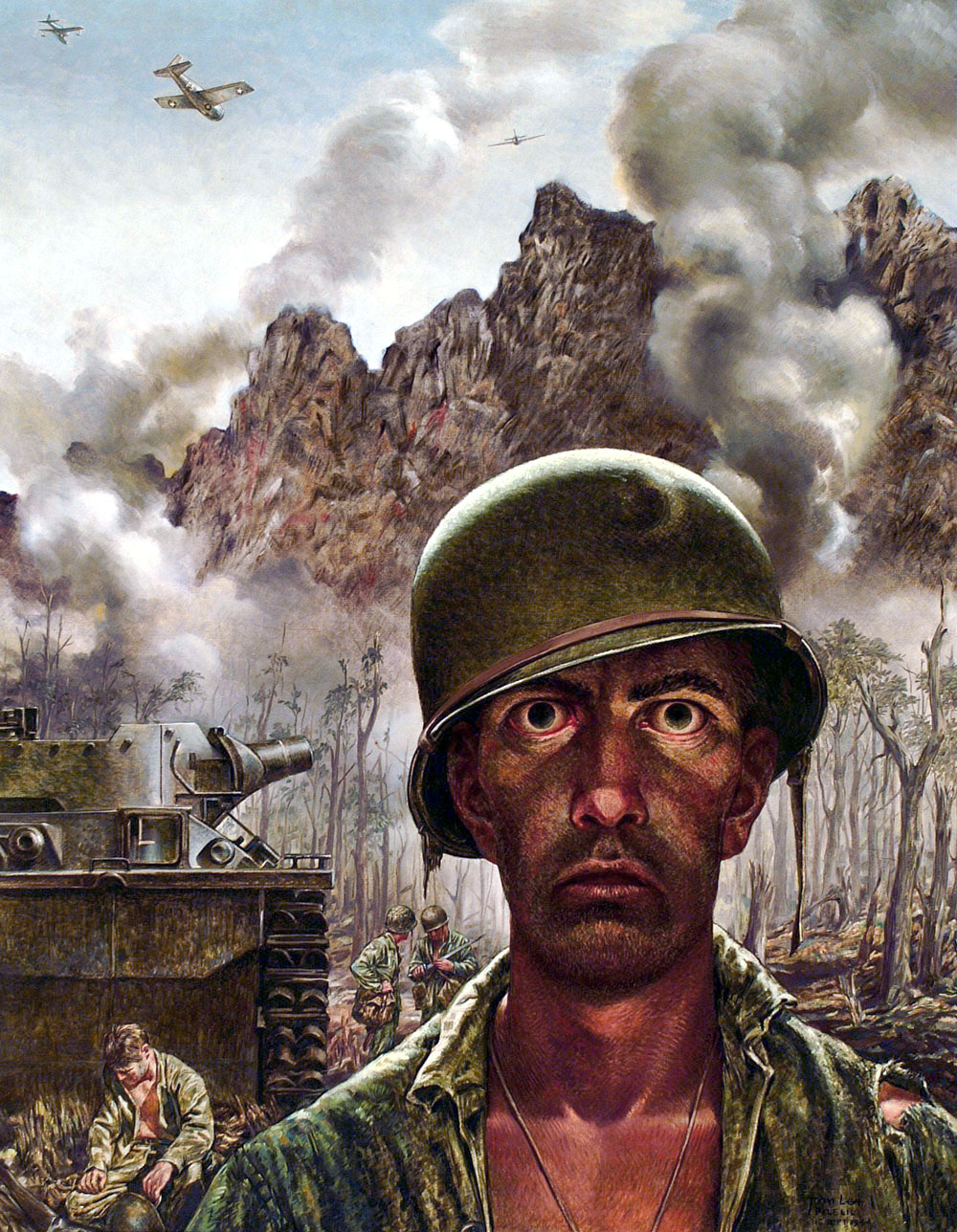
Tom Lea, “The 2,000 Yard Stare” 1944 [Oil on canvas, 36 x 28 Life Collection of Art WWII, U.S. Army Center of Military History, Fort Belvoir, Virginia]
That idea that fatigue is a human factor in combat seems relatively uncontroversial. Military history is replete with examples of how the limits of human physical and mental endurance have affected the character of fighting and the outcome of battles. Perhaps the most salient aspect of military training is preparing soldiers to deal with the rigors of warfare.
Trevor Dupuy was aware that fatigue has a degrading effect on the effectiveness of troops in combat, but he never was able to study the topic specifically himself. He was aware of other examinations of historical experience that were relevant to the issue.
An approximate value for the daily effect of fatigue upon the effectiveness of weapons employment emerged from a HERO study several years ago. There is no question that fatigue has a comparable degrading effect upon the ability of a force to advance. I know of no research to ascertain that effect. Until such research is performed, I have arbitrarily assumed that the degrading effect of fatigue upon advance rates is the same as its degrading effect upon weapons effectiveness. To those who might be shocked at such an assumption, my response is: We know there is an effect; it is better to use a crude approximation of that effect than to ignore it…
During World War II when Colonel S.L.A. Marshall was the Chief Historian of the US European Theater of Operations, he undertook a number of interviews of units just after they had been in combat. After the war, in his book Men Against Fire, Marshall asserted that his interviews revealed that only 15% of US infantry soldiers fired their small arms weapons in combat. This revelation created something of a sensation at the time.
It has since been demonstrated that Marshall did not really have solid, scientific data for his assertion. But those who criticize Marshall for unscholarly, unscientific work should realize that in private life he was an exceptionally good newspaper reporter. His conclusions, based upon his observations, may have been largely intuitive, but I am convinced that they were generally, if not specifically, sound…
One of the few examples of the use of military history in the West in recent years was an important study done at the British Defence Operational Analysis Establishment (DOAE) by David Rowland. An unclassified condensation of that study was published in the June 1986 issue of the Journal of the Royal United Services Institution (RUSI). The article, “Assessments of Combat Degradation,” demonstrates conclusively that, in historical combat, small arms weapons have had only one-seventh to one-tenth of their theoretical effectiveness. Rowland does not attempt to say why this is so, but it is interesting that his value of one-seventh is very close to the S. L. A. Marshall 15% figure. Both values translate into casualty effects very similar to those that have emerged from my own research.
The intent of this post is not to rehash the debate on Marshall. As Dupuy noted above, even if Marshall’s conclusions were not based on empirical evidence, his observations on combat were nevertheless on to something important. (Details on the Marshall debate can be easily found with a Google search. A brief discussion took place on the old TDI Forum in 2007.)
The exhaustion factor (ex) of a fresh unit is 1.0; this is the maximum ex value.
At the conclusion of an engagement, a new ex factor will be calculated for each side.
A unit in normal offensive or defensive combat has its ex factor reduced by .05 for each consecutive day of combat; the ex factor cannot be less than 0.5.
An attacking unit opposed by delaying tactics has its ex factor reduced by 0.05 per day.
A defending unit in delay posture neither loses nor gains in its ex factor.
A withdrawing unit, not seriously engaged, has its ex factor augmented at the rate of 0.05 per day.
An advancing unit in pursuit, and not seriously delayed, neither loses nor gains in its ex factor.
For a unit in reserve, or in non-active posture, an exhaustion factor of less than 1.0 is augmented at the rate of .1 per day.
When a unit in combat, or recently in combat, is reinforced by a unit at least half of its size (in numbers of men), it adopts the ex factor of the reinforcing unit or—if the ex factor of the reinforcing unit is the same or lower than that of the reinforced—both adopt an ex factor 0.1 higher than that of the reinforced unit at the time of reinforcement, save that an ex factor cannot be greater than 1.0.
When a unit in combat, or recently in combat, is reinforced by a unit less than half its size, but not less than one quarter its size, augmentations or modifications of ex factors will be 0.5 times those provided for in paragraph 9, above. When the reinforcing unit is less than one-quarter the size of the reinforced unit, but not less than one-tenth its size, augmentations or modifications of ex factors will be 0.25 times those provided for in paragraph 9, above.
* Approximate reflection of preliminary QJM assessment of effects of casualty and fatigue, WWII engagements. These rates are for division or smaller size; for corps and larger units exhaustion rates are calculated for component divisions and smaller separate units.
EXAMPLES OF APPLICATION
A division in continuous offensive combat for five days stays in the line in inactive posture for two days, then resumes the offensive:
Combat exhaustion effect: 1 – (5 x .05) = 0.75;
Recuperation effect: 75 + (2 x .l) = 0.95.
A division in defensive posture for fifteen days is ordered to undertake a counterattack:
Combat exhaustion effect: 1 – (15 x .05) =0.25; this is below the minimum ex factor, which therefore applies: 0.5;
Recuperation effect: None; ex factor is 0.5.
A division in offensive posture for three days is reinforced by two fresh brigades:
Combat exhaustion effect: 1 – (3 x .05) = 0.85;
Reinforcement effect: Augmentation from 0.85 to 1.0.
A division in offensive posture for three days is reinforced by one fresh brigade:
Combat exhaustion effect: 1 – (3 x .05) = 0.85;
Reinforcement effect: 0.5 x augmentation from 0.85 to 1 = 0.93.