Category Combat Databases

Validation

Continuing to comment on the article in the December 2018 issue of the Phalanx by Jonathan Alt, Christopher Morey and Larry Larimer (this is part 2 of 7; see part 1 here).

On the first page (page 28) top of the third column they make the rather declarative statement that:

The combat simulations used by military operations research and analysis agencies adhere to strict standards established by the DoD regarding verification, validation and accreditation (Department of Defense, 2009).

Now, I have not reviewed what has been done on verification, validation and accreditation since 2009, but I did do a few fairly exhaustive reviews before then. One such review is written up in depth in The International TNDM Newsletter. It is Volume 1, No. 4 (February 1997). You can find it here:

http://www.dupuyinstitute.org/tdipub4.htm

The newsletter includes a letter dated 21 January 1997 from the Scientific Advisor to the CG (Commanding General)  at TRADOC (Training and Doctrine Command). This is the same organization that the three gentlemen who wrote the article in the Phalanx work for. The Scientific Advisor sent a letter out to multiple commands to try to flag the issue of validation (letter is on page 6 of the newsletter). My understanding is that he received few responses (I saw only one, it was from Leavenworth). After that, I gather there was no further action taken. This was a while back, so maybe everything has changed, as I gather they are claiming with that declarative statement. I doubt it.

This issue to me is validation. Verification is often done. Actual validations are a lot rarer. In 1997, this was my list of combat models in the industry that had been validated (the list is on page 7 of the newsletter):

1. Atlas (using 1940 Campaign in the West)

2. Vector (using undocumented turning runs)

3. QJM (by HERO using WWII and Middle-East data)

4. CEM (by CAA using Ardennes Data Base)

5. SIMNET/JANUS (by IDA using 73 Easting data)


Now, in 2005 we did a report on Casualty Estimation Methodologies (it is report CE-1 list here: http://www.dupuyinstitute.org/tdipub3.htm). We reviewed the listing of validation efforts, and from 1997 to 2005…nothing new had been done (except for a battalion-level validation we had done for the TNDM). So am I now to believe that since 2009, they have actively and aggressively pursued validation? Especially as most of this time was in a period of severely declining budgets, I doubt it. One of the arguments against validation made in meetings I attended in 1987 was that they did not have the time or budget to spend on validating. The budget during the Cold War was luxurious by today’s standards.

If there have been meaningful validations done, I would love to see the validation reports. The proof is in the pudding…..send me the validation reports that will resolve all doubts.

Panzer Battalions in LSSAH in July 1943 – II

This is a follow-up to this posting:

Panzer Battalions in LSSAH in July 1943

The LSSAH Panzer Grenadier Division usually had two panzer battalions. Before July the I Panzer Battalion had been sent back to Germany to arm up with Panther tanks. This had lead some authors to conclude that in July 1943, the LSSAH had only the II Panzer Battalion. Yet the unit’s tank strength is so high that this is hard to justify. Either the LSSAH Division in July 1943 had:

  1. Over-strength tank companies
  2. A 4th company in the II Panzer Battalion
  3. A temporary I Panzer Battalion

I have found nothing in the last four months to establish with certainly what was the case, but additional evidence does indicate that they had a temporary I Panzer Battalion.

The first piece of evidence is drawn from a division history book, called Liebstandarte III, by Rudolf Lehmann, who was the chief of staff of the Panzer Regiment. It states that they had around 33 tanks at hill 252.2 on the afternoon or evening of the 11th. It has been reported that the entire II Panzer Battalion moved up there on the 11th, and then pulled back their 5th and 7th companies, leaving the 6th company in the area of hill 252.2. The 6th Panzer Company was reported to have only 7 tanks operational on the morning of the 12th. So, II Panzer Battalion may have had three companies of 7-12 tanks each, and the battalion staff, and maybe some or all of the regimental staff there. The LSSAH Division according to the Kursk Data Base had as of the end of the day on 11 July 1943: 2 Panzer Is, 4 Panzer IIs, 1 Panzer III short, 4 Panzer III longs, 7 Panzer III Command tanks, 47 Panzer IV longs and 4 Panzer VIs for a total of 69 tanks in the panzer regiment. Ignoring the 4 Tiger tanks, this leaves 32 tanks unaccounted for. This could well be the complement of a temporary I Panzer Battalion.

The second unresolved issue is that the Soviet XVIIII Tank Corps is reported to have encountered dug-in tanks as they tried to push beyond Vasilyevka along the Psel River. They reported that their advance was halted by tank fire from the western outskirts of Vasilyevka. They also report at 1400 (Moscow time) repulsing a German counterattack by 50 tanks from the Bogoroditskoye area (just west of Vasilyevka, south of the Psel).

With the II Panzer Battalion being opposite the XXIX Tank Corps, then one wonders who and where those “dug-in tanks” were from. It is reported in some sources that the Tiger company, which was in the rear when the fighting started, moved to the left flank, but most likely there was another tank formation there. If the II Panzer Battalion was covering the right half of the LSSAH’s front, then it would appear that the rest of the front would have been covered by a temporary I Panzer Battalion of at least three companies.

This leads to me lean even more so to the conclusion that the LSSAH had a temporary I Panzer Battalion of at least three companies, the II Panzer Battalion of three companies, and the Tiger company, which was assigned to the II Panzer Battalion.

Amphitheater, 9 – 11 September 1943

There used to be an engagement called “The Amphitheater, 9-11 July 1943′ in our databases. It was in the Land Warfare Data Base (LWDB) and we moved it over to our Division-Level Engagement Data Base (DLEDB). We did revise it. It now consists of two engagements:

Amphitheater Beachhead, 9 September: Created for EPW Study by Richard Anderson on 30 September 1998.

Amphitheater (rev), 10-11 September: Extensively revised 30 October for EPW study by Richard Anderson. Original engagement no. 3940 deleted.

Amphitheater Beachhead:

Engagement No:    23002

Duration:                  1 Day

Front Width:             3.5 km

Force Name:            Br 56th Infantry Division       Ger KG Stempel, 16th PzD

Total Strength:         12,480                                   5,241

Total Armor:                    52                                        27

Artillery Pieces:             110                                        36

Total Casualties:           444                                      142

Armor Losses:                 10                                         3

Artillery Losses:                 4                                       14

Enemy Captured:            54                                     120

Amphitheater (rev):

Engagement No:      23005

Duration:                   2 Days

Front Width:              13 km

Force Name:             Br 56th Infantry Division       Ger KG Stempel (+), 16th PzD

Total Strength:          12,036                                  10,271

Total Armor:                     42                                         90

Artillery Pieces:              106                                         38

Total Casualties:         1,213                                       478

Armor Losses:                   7                                          44

Artillery Losses:                 1                                         —

Enemy Captured:            23                                        725

This is response to the discussion under this post:

More on the QJM/TNDM Italian Battles

The DLEDB consists of 752 division-level engagements from 1904 to 1991. There are 121 fields per engagement, including 5 text fields. It is programmed in Access. It is company proprietary.

Cost of Creating a Data Base

Soviet Tank Repairs at Kursk (part 2 of 2)

This first blog post on this subject strongly made the point that the Russian armor repair effort was not at the same level as the German efforts, which is what I observed when assembling the Kursk Data Base (KDB). But, Zamulin, Demolishing the Myth, continued on pages 448-449, touting what a great job the repair people did. I figured for completeness, I needed to post this.

To continue P. A. Rotmistrov’s (Fifth Guards Tank Army commander) quote from the previous posting:

The mechanics’ profile was diverse. The 83rd Army-level Repair-Recovery Battalion and the corps’ mobile repair depots were staffed with qualified workers from the tank industry (the Stalingrad and Khar’kov factories), but who lacked work experience in field conditions. The tank brigade equipment companies, on the other hand, were staffed primarily with specialists on the repair of armored vehicles under combat conditions. Such a combination of cadres on the whole produced satisfactory results.

Major overhauls, like engine, gun, and turret replacements, were performed at the mobile repair depots of the tank corps. Each tank corps had two of these repair depots, each staffed with 70 to 80 men. For urgent repairs just 8-10 kilometers from the front lines, two army-level, three corps-level and nine brigade collection points for disabled vehicles were set up, which shared all the repair-recovery resources.

On the night of 12 July, as the 5th Guard Tank Army commander later remembered:

The repair workers faced the task of restoring and repairing parts and components, stripped from irreparably damaged tanks from those tanks that needed major overhauls. We had to get hold of 45 engines, 20 gear boxes and several engine and steering clutches. All of the recover and repair units and teams of the separate regiments, brigades, and corps and the army were mobilized to accomplish this task.

To what Rotmistrov said I will add that in order to hasten the repair of the 5th Guard Tank Army’s damaged armored vehicles, the Front’s Armored and Mechanized Forces commander transferred 167 field repair depots from the 38th Army to the 5th Guards Tank Army on 14 July. The truly heroic effort produced results. Of the 420 damaged tanks in its brigades and regiments after the fighting of 12 July, 112 requiring minor or moderate repairs were restored to operation in the very first days after the battle. In addition, the Front command took other steps to assist the army. Already by 15 July, just three days after the engagement, the 5th Guards Tank Army began to receive new tanks. The 29th Tank Corps was the first to begin to received the new vehicles. The 31st Tank Brigade’s war diary notes, “15 July….An order arrived to pick up 16 T-34 tanks at Solntesevo Station. A procurement team had been sent.”

Force Ratios in Conventional Combat

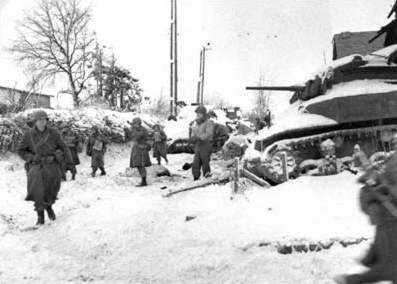
American soldiers of the 117th Infantry Regiment, Tennessee National Guard, part of the 30th Infantry Division, move past a destroyed American M5A1 “Stuart” tank on their march to recapture the town of St. Vith during the Battle of the Bulge, January 1945. [Wikipedia]
[This piece was originally posted on 16 May 2017.]

This post is a partial response to questions from one of our readers (Stilzkin). On the subject of force ratios in conventional combat….I know of no detailed discussion on the phenomenon published to date. It was clearly addressed by Clausewitz. For example:

At Leuthen Frederick the Great, with about 30,000 men, defeated 80,000 Austrians; at Rossbach he defeated 50,000 allies with 25,000 men. These however are the only examples of victories over an opponent two or even nearly three times as strong. Charles XII at the battle of Narva is not in the same category. The Russian at that time could hardly be considered as Europeans; moreover, we know too little about the main features of that battle. Bonaparte commanded 120,000 men at Dresden against 220,000—not quite half. At Kolin, Frederick the Great’s 30,000 men could not defeat 50,000 Austrians; similarly, victory eluded Bonaparte at the desperate battle of Leipzig, though with his 160,000 men against 280,000, his opponent was far from being twice as strong.

These examples may show that in modern Europe even the most talented general will find it very difficult to defeat an opponent twice his strength. When we observe that the skill of the greatest commanders may be counterbalanced by a two-to-one ratio in the fighting forces, we cannot doubt that superiority in numbers (it does not have to more than double) will suffice to assure victory, however adverse the other circumstances.

and:

If we thus strip the engagement of all the variables arising from its purpose and circumstance, and disregard the fighting value of the troops involved (which is a given quantity), we are left with the bare concept of the engagement, a shapeless battle in which the only distinguishing factors is the number of troops on either side.

These numbers, therefore, will determine victory. It is, of course, evident from the mass of abstractions I have made to reach this point that superiority of numbers in a given engagement is only one of the factors that determines victory. Superior numbers, far from contributing everything, or even a substantial part, to victory, may actually be contributing very little, depending on the circumstances.

But superiority varies in degree. It can be two to one, or three or four to one, and so on; it can obviously reach the point where it is overwhelming.

In this sense superiority of numbers admittedly is the most important factor in the outcome of an engagement, as long as it is great enough to counterbalance all other contributing circumstance. It thus follows that as many troops as possible should be brought into the engagement at the decisive point.

And, in relation to making a combat model:

Numerical superiority was a material factor. It was chosen from all elements that make up victory because, by using combinations of time and space, it could be fitted into a mathematical system of laws. It was thought that all other factors could be ignored if they were assumed to be equal on both sides and thus cancelled one another out. That might have been acceptable as a temporary device for the study of the characteristics of this single factor; but to make the device permanent, to accept superiority of numbers as the one and only rule, and to reduce the whole secret of the art of war to a formula of numerical superiority at a certain time and a certain place was an oversimplification that would not have stood up for a moment against the realities of life.

Force ratios were discussed in various versions of FM 105-5 Maneuver Control, but as far as I can tell, this was not material analytically developed. It was a set of rules, pulled together by a group of anonymous writers for the sake of being able to adjudicate wargames.

The only detailed quantification of force ratios was provided in Numbers, Predictions and War by Trevor Dupuy. Again, these were modeling constructs, not something that was analytically developed (although there was significant background research done and the model was validated multiple times). He then discusses the subject in his book Understanding War, which I consider the most significant book of the 90+ that he wrote or co-authored.

The only analytically based discussion of force ratios that I am aware of (or at least can think of at this moment) is my discussion in my upcoming book War by Numbers: Understanding Conventional Combat. It is the second chapter of the book: https://dupuyinstitute.org/2016/02/17/war-by-numbers-iii/

In this book, I assembled the force ratios required to win a battle based upon a large number of cases from World War II division-level combat. For example (page 18 of the manuscript):

I did this for the ETO, for the battles of Kharkov and Kursk (Eastern Front 1943, divided by when the Germans are attacking and when the Soviets are attacking) and for PTO (Manila and Okinawa 1945).

There is more than can be done on this, and we do have the data assembled to do this, but as always, I have not gotten around to it. This is why I am already considering a War by Numbers II, as I am already thinking about all the subjects I did not cover in sufficient depth in my first book.

Wargaming Thread on Combat Results Tables

Thanks to a comment made on one of our posts, I recently became aware of a 17 page discussion thread on combat results tables (CRT) that is worth reading. It is here:

https://www.boardgamegeek.com/thread/1344914/crts-101/page/1

By default, much of their discussion of data centers around analysis based upon Trevor Dupuy’s writing, the CBD90 database, the Ardennes Campaign Simulation Data Base (ACSDB), the Kursk Data Base (KDB)  and my book War by Numbers. I was not aware of this discussion until yesterday even though the thread was started in 2015 and continues to this year (War by Numbers was published in 2017 so does not appear until the end of page 5 of the thread).

The CBD90 was developed from a Dupuy research effort in the 1980s eventually codified as the Land Warfare Data Base (LWDB). Dupuy’s research was programmed with errors by the government to create the CBD90. A lot of the analysis in my book was based upon a greatly expanded and corrected version of the LWDB. I was the program manager for both the ACSDB and the KDB, and of course, the updated versions of our DuWar suite of combat databases.

http://www.dupuyinstitute.org/dbases.htm

There are about a hundred comments I could make to this thread, some in agreement and some in disagreement, but then I would not get my next book finished, so I will refrain. This does not stop me from posting a link:

Lanchester equations have been weighed….


Das Reich Tank Losses on 6 July, 1943

On 6 July 1943, we estimate that the Das Reich SS Division lost 30 tanks damaged and destroyed. We have them starting the battle on the evening of 4 July with the following:

Pz I Command:                1

Pz II:                                 0 (and 1 in repair)

Pz III short (Command):   8

Pz III short:                       1

Pz III long:                       52 (and 11 in repair)

Pz III Observation:            9 (not counted)

Pz III Command:               1

Pz IV long:                       30 (and 2 in repair)

Pz VI:                               12 (and 2 in repair)

StuG III:                            33

Marder II:                           2 (and one in repair)

Marder III 76.2mm:            8

T-34:                                18 (and 9 in repair)


Total                               166 (and 26 in repair)


This is from the Kursk Data Base (KDB).

Tank status report for 5 July from 4th PzA files (T313, R366, page 2209), no time given. It records:

Pz III short: 1

Pz III long: 45

Pz IV: 27

Pz VI: 12

Command: Not reported

StuG: 32


This file was not used. There are some errors in other parts of this report. The file we did use was 5.7.43 19:40 hours from the army files (T313, R368. page 4282), which states:

Pz III short: 1

Pz III long: 52

Pz IV long: 27

Pz VI: 11

T-34: 16

Command: 8

StuG: 21


It took me a while to find all these files, which is why this blog post was so late today.

The next report from Das Reich is at 0235 on 7 July. Not sure why the delay, as the other division’s in the corps were submitting daily reports. They report:

Pz III short: 1

Pz III long: 47

Pz IV: 16

Pz VI: 7

Command: 6

StuG: 14

Total losses: 1 Pz IV.


We assume that this report at 0235 on 7 July is the end of the day report for July 6. That gives us a count of at least 47-48 tanks lost since the start of the offensive. One will note that they claim only one tank completely lost, yet there are six tanks listed destroyed in the gully SSW of Luchki. Is this an indication that they may have been lost on subsequent days and towed there?

The Kursk Data Base records 19 tanks damaged/destroyed on the 5th and 30 tanks damaged/destroyed in the 6th. These counts include T-34 losses. On the 6th this includes 2 Pz III short (Command), 5 Pz III longs, 11 Pz IV longs (one listed as destroyed), 4 Pz VIs, 7 StuG IIIs, and 1 T-34.

The status report for 7 July is probably in the message of 8 July dated at 0830, which list tank status from 6.7.43. This could be a 7 July report and was used as such in the Kursk Data Base. It is from 4th Panzer Army files (T313, R366, page 2251):

Pz III: 43

Pz IV: 25

Pz VI: 6

Command tank: 7

T-34: 14

Stug: 7 (!)


Status report for 8 July (from 4th Panzer Army files, T313, R366, page 2247):

Pz III long: 31

Pz IV long: 14

Pz VI: 0  (hard to read)

Command Tank: 7

T-34: 12

StuG: 21


Report does have a handwritten figure of 45 next to it (31+14 = 45)

The next report of tank status we have for Das Reich is for 9 July. They report:

                           Division      Corps (1830)     Corps (1905)   4th PzA Report (2300)

Pz III short:            0

Pz III long:           31                   33                   31                      38 (31)

Pz IV:                  13                   15                    13                     13

 Pz VI:                   1                     1                      1                       1

Command tank:    7                     7                      7                            (7)

T-34:                     7                     7                      7

Stug:                   26                   26                    26                       26


For the Kursk Data Base, these were the nuts and bolt calculations we did for all nine German panzer and panzer grenadier divisions for all 15 days of the operation. We also did the same for all 10 Soviet tank and mechanized corps. While we may have made a error here and there on a given day, we did try to count and track tank strengths and losses for every single day, even when the records were not cooperating. I believe the KDB is the most accurate accounting of tank losses at the Battle of Kursk.

Anyhow, this is related to this previous post, as I am still trying to sort out what might of occurred near the village of Luchki on 6 July, 1943:

The Das Reich Valley of Death?

With six tanks reported destroyed to the SSW of Luchki, perhaps all on 6 July, and the Das Reich SS Division losing around 30 tanks on 6 July, there may have been a major fight there that is not otherwise documented.

The Tank Repair and Replacement Efforts of II Guards Tank Corps compared to Totenkopf SS Division

As I result of a discussion I am having about Kursk with Niklas Zetterling, I have decided to compare the actual repair and replacement efforts of the Soviet II Guards Tank Corps to the German Totenkopf (Death’s Head) SS Panzer Grenadier Division. The II Guard Tank Corps was selected as it has some of the more complete records and it maintained its position in the “Donets triangle” from the beginning of the battle on 5 July 1943 until the 15th of July 1943. Its headquarters at Kosukhin on 4 July (can’t locate), it was at Kalinin on 6 July (305455?), and it was at Sazhnoye (3734)  by 0700 7 July, moved to Kleimenovo (4037) by 0700 10 July, moved to Plota (4345) by 0700 11 July, moved to Zhilomostnoye (4048) by 0700 12 July, and moved to Bereznik (490555), 3 km east of Krasnoye by 0700 15 July. The unit was never overrun or forced back by an attack, so it was in a decent position to repair and replace tanks.

The Totenkopf was selected as it was the German armor unit nearest to it and engaged with it. The Totenkopf SS Division ended up holding down the SS Panzer Corps right flank until the 9th, when it then moved up to cross the Psel River and try to take Prokhorovka from the north-northwest.

So lets look at Totenkopf for a moment (this is data from the Kursk Data Base):

Date       Tank Strength*     Destroyed     Damaged   In Repair    Returned to Duty

7/04        165                         0                      0                11

7/05        150                         1                    14

7/06        139                         3                      8

7/07        133                         1                      7                               2

7/08        122                         2                      9                               0

7/09        105                         4                    15                               2

7/10        116                         0                      0                             11

7/11        134                         0                      3                             21

7/12        106                         3                    25                               0

7/13          77                         2                    27                               0

7/14          76                         2                     6                                7

7/15          80                         0                     1                                5

7/16          97                         0                     0                              17

7/17          98                         0                     2                                3

7/18          96                         0                     2                                0

Total                                    18                 119                              68

* On 4 July this tank strength consisted of 59 Pz III long, 8 Pz III Command, 7 Pz IV short, 40 Pz IV long, 11 Pz VI, 1 Pz VI Command, 28 SuG III and 11 Marder IIs. AFVs not included in this count are 5 Pz III Observation, 5 Hummel, 12 Wespe, 36 armored cars, 56 light halftracks (including 3 250/10 with 37mm AT) and 69 medium halftracks (including 2 251/9 with 75mm lt IG and 7 251/10 with 37mm AT).

Strength figures are nominally as of 1800 on that day.

It appears that around 13% of the tanks destroyed/damaged/broken-down were written-off as destroyed. The Totenkopf SS Division appears to have repaired 57% of the damaged tanks during this time (and they may have repaired more later).

Now, let us look at the II Guards Tank Corps (also data from the Kursk Data Base)

Date       Tank Strength     Destroyed     Damaged    In repair    Returned to Duty

7/04        187  *                   0                   0                30  **           0

7/05        187                      0                    0                30               0

7/06        159                    17                  11                41               0

7/07        171                      0                    7                29  **        19 T-34s **

7/08        155                      6                  10                39               0

7/09        133                      7                  23                54               5-8 Churchills ***

7/10        139                      0                    2                48               8

7/11        140                      3                    2                44               6 (4 Churchills)

7/12          82                    24                  35                78               0-1 Churchill

7/13          80                      1                    4                                   3

7/14          59                    13                    8                                   0

7/15          57                      2                  14                                 14 T-34s ****

7/16          63                      0                    0                                   6 ****

7/17          63                      0                    0                                   0

7/18          31                      9                  25                                   2

Total                                 82                141                                 63-67

    Less tanks that were probably not repaired:                         – 19

    Less the confusing Churchill reports:                                    –   9 – 13

Total returned to duty (RTD) was probably around:                    35

* On 4 July this tank strength consisted of 99 T-34s, 72 T-70s and 16 Churchills. The unit also had 28 BA-64 (armored cars) and 20 Bren Gun Carriers. Note that there is another report that records the corps on 4 July as having 121 T-34s, 75 T-70s, 21 Churchills (Fond: 2nds GTC, Opis: 1, Delo: 23, pages 4-9). We believe this is total tanks, not just tanks ready-for-action.

It appears that around 37% of the tanks destroyed/damaged/broken-down were written-off as destroyed. The II Guards Tank Corps appeared to repair 45% of the damaged tanks during this time (and they may have repaired more later), but as 28 of these repairs were probably not repaired tanks (see the ** and *** remarks below), then it appears that they repaired around 25% of the damaged tanks during this time.

So, compared to the Germans, the Soviet unit wrote off a higher percentage of tanks written off as destroyed (13% versus 37%) and a lower percentage of damaged tanks repaired (57% repaired versus 25% repaired). This is pretty typical for all the German panzer and panzer grenadier divisions compared to Soviet tank and mechanized corps at Kursk. Also, most of the Soviet repaired arrived on the 15th and 16th, after the battle was winding down.


——————————————————————————————————————–

P.S. The map is of the II Guards Tank Corps operation on 6 July 1943 from page 475 of my book. It is the II Guards Tank Corps map for 1800, 6 July 1943.

P.P.S.: The remaining notes are here:

** These tanks almost certainly are reserve T-34s, vice recently repaired ones. In operational report #181, dated 0700 8 July, they list a corps reserve of 20 T-34s and 10 T-70s. They state that “the 20 tanks in corps reserve are located in Bubnovo.” I have yet to locate Bubnovo on a map.The keeping of 20 or 30 spared tanks was a normal practice at Kursk at this time. The difference between the ready-for-action reports and other tank counts on 4 July do indicate that there was a spare 22 T-34s, 3 T-70s, and 5 Churchills with the unit (see the * remark). The 19 RTD tanks are certainly the 20 spare tanks activated. This is the only mention of the “corps reserve’ in the II Guards Tank Corps records we have.

*** These are all Churchills. From 7/09 through 7/12 we have 9-13 Churchills RTD. The actual report of Churchill strength and losses from 7/08 – 7/13 is confusing:

0700 7/08: 1. 5 Churchills at 2400 July 7

                  2. Combat ready tanks: 5 Churchills (from 2 reports)

0700 7/09: 1. 5 Churchills.

                  2. Losses on July 8: 2 Churchills burned, 3 Churchills knocked out.

0700 7/10: 1. “The regiment suffered losses, including 2 Churchills burned, out of 5 combat-ready.”

                   2. “47ths Gds Heavy Tank Rgt, with 3 Churchills is in the area of Khokhlovo….”

                   3. On July 9 the corps lost 1 Churchill burned and 1 Churchill knocked out.

                   4. Combat ready tanks: 3 Churchills (2 reports)

                   5. Corps lost 5 Mk-4s on 9 July (from a different report)

0700 7/11: Combat ready tanks: 3 Churchills (2 reports)

0700 7/12: 1. “47th Gds Heavy Tank Rgt, with 6 Churchills…”

                  2. At 2400 on July 11…..47th Gds Heavy tank Rgt, consisting of 2 Churchills, is in the corps commander reserve north of Leski.

                  3. Corps losses for July 11: 3 Churchills burned, 2 Churchills knocked out.

                  4. Combat Ready Tanks: 2 Churchills (2 reports)

0700 7/13: Report is missing

0700 7/14: Combat Ready Tanks: 2 Churchills

The unit, the 47th Guards Heavy Tank Regiment, was operating independent of the corps, having gotten separated on the 7th and moved over to face the III Panzer Corps.  It appear unlikely over these three days that 16-19 Churchills were damaged or broken down, and that 13-16 of them were repaired, but this is the only way to get totals to work. It is either that assumption, or one has to dismiss some parts of the records as in error, and it is hard to know what to dismiss. This is most likely anomalous data in the II GTC records.

**** These 14 tanks we believe are repaired. they reported at 0700 15 July to have combat-ready 30 T-34s, 12 T-70s, and 2 Churchills, they report losses for 15 July of 6 T-34s knocked out, 1 T-34 burned, 2 T-70s knocked out, 1 burned (10 tanks total) and they reported on 0700 16 July combat-ready 45 T-34s, 18 T-70s. Another report for the 16th states that “following repairs, the corps had the following tanks in line: 38 T-34s and 15 T-70s.”

P.P.P.S. The Totenkopf SS Division lost around 57 tanks on 12th and 13th of July (and we don’t know how many were actually lost on what given day). Some authors, in their accounts of Prokhorovka seem to ignore its efforts and its losses, even though it was engaged with elements of Rotmistrov’s Fifth Guards Tank Army and its objective was Prokhorovka (which it did not achieve).

Measuring the Effects of Combat in Cities, Phase II – part 1

Our first urban warfare report that we did had a big impact. It clearly showed that the intensity of urban warfare was not what some of the “experts” out there were claiming. In particular, it called into question some of the claims being made by RAND. But, the report was based upon Aachen, Cherbourg, and a collection of mop-up operations along the Channel Coast. Although this was a good starting point because of the ease of research and availability of data, we did not feel that this was a fully representative collection of cases. We also did not feel that it was based upon enough cases, although we had already assembled more cases than most “experts” were using. We therefore convinced CAA (Center for Army Analysis) to fund a similar effort for the Eastern Front in World War II.

For this second phase, we again assembled a collection of Eastern Front urban warfare engagements in our DLEDB (Division-level Engagement Data Base) and compared it to Eastern Front non-urban engagements. We had, of course, a considerable collection of non-urban engagements already assembled from the Battle of Kursk in July 1943. We therefore needed a good urban engagement nearby. Kharkov is the nearest major city to where these non-urban engagements occurred and it was fought over three times in 1943. It was taken by the Red Army in February, it was retaken by the German Army in March, and it was taken again by the Red Army in August. Many of the units involved were the same units involved in the Battle of Kursk. This was a good close match. It has the additional advantage that both sides were at times on the offense.

Furthermore, Kharkov was a big city. At the time it was the fourth biggest city in the Soviet Union, being bigger than Stalingrad (as measured by pre-war population). A picture of its Red Square in March 1943, after the Germans retook it, is above.

We did have good German records for 1943 and we were able to get access to Soviet division-level records from February, March and August from the Soviet military archives in Podolsk. Therefore, we were able to assembled all the engagements based upon the unit records of both sides. No secondary sources were used, and those that were available were incomplete, usually one-sided, sometimes biased and often riddled with factual errors.

So, we ended up with 51 urban and conurban engagements from the fighting around Kharkov, along with 65 non-urban engagements from Kursk (we have more now).

The Phase II effort was completed on 30 June 2003. The conclusions of Phase II (pages 40-41) were similar to Phase I:

.Phase II Conclusions:

  1. Mission Accomplishment: This [Phase I] conclusion was further supported. The data does show a tendency for urban engagements not to generate penetrations.
  2. Casualty Rates: This [Phase I] conclusion was further supported. If urban combat influenced the casualty rate, it appears that it resulted in a reduction of the attacker casualty rate and a more favorable casualty exchange ratio compared to nonurban warfare. There still appears to be no basis to the claim that urban combat is significantly more intense with regards to casualties than is nonurban warfare.
  3. Advance Rates: There is no strong evidence of a reduction in the advance rates in urban terrain in the Eastern Front data. TDI still stands by its original conclusion that the average advance rate in urban combat should be one-half to one-third that of nonurban combat.
  4. Linear Density: Again, there is little evidence that the presence of urban terrain results in a higher linear density of troops, but unlike the ETO data, the data did not show a tendency to trend in that direction.
  5. Armor Losses: This conclusion was further supported (Phase I conclusion was: Overall, it appears that the loss of armor in urban terrain is the same as or less than that found in nonurban terrain, and in some cases is significantly lower.)
  6. Force Ratios: The conclusion was further supported (Phase I conclusion was: Urban combat did not significantly influence the Force Ratio required to achieve success or effectively conduct combat operations).
  7. Duration of Combat: Nothing could be determined from an analysis of the data regarding the Duration of Combat (Time) in urban versus nonurban terrain.

There is a part 2 to this effort that I will pick up in a later post.

My Response To My 1997 Article

Shawn likes to post up on the blog old articles from The International TNDM Newsletter. The previous blog post was one such article I wrote in 1997 (he posted it under my name…although he put together the post). This is the first time I have read it since say….1997. A few comments:

  1. In fact, we did go back in systematically review and correct all the Italian engagements. This was primarily done by Richard Anderson from German records and UK records. All the UK engagements were revised as were many of the other Italian Campaign records. In fact, we ended up revising at least half of the WWII engagements in the Land Warfare Data Base (LWDB).
  2. We did greatly expand our collection of data, to over 1,200 engagements, including 752 in a division-level engagement database. Basically we doubled the size of the database (and placed it in Access).
  3. Using this more powerful data collection, I then re-shot the analysis of combat effectiveness. I did not use any modeling structure, but simply just used basic statistics. This effort again showed a performance difference in combat in Italy between the Germans, the Americans and the British. This is discussed in War by Numbers, pages 19-31.
  4. We did actually re-validate the TNDM. The results of this validation are published in War by Numbers, pages 299-324. They were separately validated at corps-level (WWII), division-level (WWII) and at Battalion-level (WWI, WWII and post-WWII).
  5. War by Numbers also includes a detailed discussion of differences in casualty reporting between nations (pages 202-205) and between services (pages 193-202).
  6. We have never done an analysis of the value of terrain using our larger more robust databases, although this is on my short-list of things to do. This is expected to be part of War by Numbers II, if I get around to writing it.
  7. We have done no significant re-design of the TNDM.

Anyhow, that is some of what we have been doing in the intervening 20 years since I wrote that article.