“Historical data on direct-fire engagements “shows that our enemies generally shoot first 80 percent of the time,” Sando said. “We don’t like those odds, [so] we want to avoid the close fight if we can. If we can’t avoid it, we want to enter it under conditions that are favorable to us.”
The question was: did this statistic come from us or do we know where it came from? Well, it definitely did not come from our work or Trevor Dupuy’s work. I have never heard of such a claim before.
Does anyone know where this came from? Is there some study or piece of quantitative historical analysis that this claim is based upon. I have my doubts about the accuracy of this claim.
If the data was drawn from unconventional (recent) warfare scenarios, then by nature of those conflicts, the insurgents initiate engagements more often than the counterinsurgents do. Not sure it would be as high as 4-to-1.
If it was drawn from conventional war scenarios, then by their nature it should be 50/50, unless you are always the attacker. Even then I am not it would be as high as 4-to-1.
Below is an article on the counts of losses from Nagorno-Karabakh. It is based upon viewing of drone footage, etc. by individuals some distance from the conflict. The numbers should be viewed with considerable caution. https://www.oryxspioenkop.com/2020/09/the-fight-for-nagorno-karabakh.html
They state: “This list only includes destroyed vehicles and equipment of which photo or videographic evidence is available. Therefore, the amount of equipment destroyed is undoubtedly higher than recorded here.”
In case you have been distracted by all the U.S. news lately, there has been a significant conflict for the last month between Azerbaijan-Armenia over Nogorno-Karabakh that resulted in dozens of tanks lost, many due to drones and loitering munitions. This is conventional war. We have not done any systematic analysis of this, so I am hesitant to make any comments on it, but it is a significant event, in that a number of Armenian tanks were taken out by Azerbaijani drones. I have found the twitter accounts @RALee85 and @Rebel44CZ and @oryxspioenkop to be worth following. They tend to include a lot of the videos that have been released from this fight.
This is an article on the subject that came out this week:
Open source analysis by Forbes magazine has tracked the destruction by drones of around 200 tanks, infantry fighting vehicles and armored personnel carriers, plus 300 soft-skinned military vehicles.
It is kind of one-sided, as Armenia does not have such a collection of drones (it helps to have oil).
The Dupuy Institute does occasionally make use of a combat model developed by Trevor Dupuy called the Tactical Numerical Deterministic Model (TNDM). That model is a development of his older model the Quantified Judgment Model (QJM).
There is an impression, because the QJM is widely known, that the TNDM is heavily involved in our work. In fact, over 90% of our work has not involved the TNDM. Here a list of major projects/publications that we done since 1993.
Based upon TNDM:
Artillery Suppression Study – study never completed (1993-1995)
Air Model Historical Data feasibility study (1995)
Support contract for South African TNDM (1996?)
International TNDM Newsletter (1996-1998, 2009-2010)
TNDM sale to Finland (2002?)
FCS Study – 2 studies (2006)
TNDM sale to Singapore (2009)
Small-Unit Engagement Database (2011)
Addressed the TNDM:
Bosnia Casualty Estimate (1995) – used the TNDM to evaluate one possible scenario
Casualty Estimation Methodologies Study (2005) – was two of the six methodologies tested
Data for Wargames training course (2016)
War by Numbers (2017) – addressed in two chapters out of 20
Did not use the TNDM:
Kursk Data Base (1993-1996)
Landmine Study for JCS (1996)
Combat Mortality Study (1998)
Record Keeping Survey (1998-2000)
Capture Rate Studies – 3 studies (1998-2001)
Other Landmine Studies – 6 studies (2000-2001)
Lighter Weight Armor Study (2001)
Urban Warfare – 3 studies (2002-2004)
Base Realignment studies for PA – 3 studies (2003-2005)
Chinese Doctrine Study (2003)
Situational Awareness Study (2004)
Iraq Casualty Estimate (2004-2005)
The use of chemical warfare in WWI – feasibility study (2005?)
Battle of Britain Data Base (2005)
1969 Sino-Soviet Conflict (2006)
MISS – Modern Insurgency Spread Sheets (2006-2009)
Our bread and butter was all the studies that “did not use the TNDM.” Basically the capture rate studies, the urban warfare studies and the insurgencies studies kept us steadily funded for year after year. We would have not been able to maintain TDI on the TNDM. We had one contract in excess of $100K in 1994-95 (the Artillery Suppression study) and our next TNDM related contract that was over $100K was in 2005.
Over the last week fighting has erupted between Armenia and Azerbaijan over the region of Nagorno-Karabakh. Nagorno-Karabakh is an area of Azerbaijan that broke away from Azerbaijan with the help of Armenia when the Soviet Union was breaking up in 1991. They went to war over it in 1991-92 and Nagorno-Karabakh declared itself the independent Republic of Artsakh on 10 December 1991.
Not sure what caused this conflict in the Caucasus to flair back up, Both of these nations have a surplus of old Soviet tanks and armored personnel carriers and fighting vehicles. The predominantly Christian Armenia tends to be supported by Russia while the predominantly Muslim Azerbaijan tends to be supported by Turkey. This is not the first time in history that Russia and Turkey had an argument over this region.
There was an article published yesterday that I found interesting:
I was on the phone with someone earlier today and he told me that Attrition: Forecasting Battle Casualties and Equipment Losses in Modern War was on sale on Amazon.com for only $900. I took a look, and sure enough, they have used one for $121.00 and a new one $890. That is it.
I think the following posts make the cases that the three-to-one rule as presented in Army FM 6-0 and other publications is incorrect (50% chance of the defender winning at 3-to-1). If there is any historical evidence that supports this claim, then I would ask that TRADOC, which is responsible for these manuals, to produce such evidence. I strongly suspect there is no such evidence. I would hope that we will see corrective action from TRADOC.
Now, I don’t know what percent of German or Soviet tanks at Kursk were killed by other tanks, as opposed to antitank guns, mines, air attacks, infantry attacks, broken down, etc. The only real data we have on this is a report from the Soviet First Tank Army which states that 73% of their tanks were lost to AP shot.
Do not know what percent of the AP shots was fired from tanks vice towed AT guns. I would be tempted to guess half. So maybe 36% of the Soviet tanks destroyed was done by other tanks? This is a very rough guess. Suspect it may have been a lower percent with the Germans.
Still, it is natural to want to compare tank losses with tank losses. The Germans during the southern offensive at Kursk had 226 tanks destroyed and 1,310 damaged. This includes their self-propelled AT guns (their Marders).
The Soviet units during the southern offensive at Kursk had 1,379 tanks destroyed and 1,092 damaged. This includes their self-propelled AT guns, the SU-152s, SU-122s and the more common SU-76s. If I count SU-76s in the Soviet tank losses, then I probably should count the Marders in the German losses.
So….comparing total losses to total losses results in 1,536 German tanks damaged or destroyed versus 2,471 Soviet tanks damaged or destroyed. This is a 1-to-1.61 exchange ratio.
On the other hand, some people like to only compare total destroyed. This comes out to a rather lop-sided 1-to-6.10 exchange ratio.
A lot of sources out there compare only lost tanks to lost tanks. This provides, in my opinion, a very distorted figure of combat effectiveness or what is actually occurring out on the battlefield.
Added to this some sources have been known to remove German command tanks from their counts of strengths and losses, even though at this stage the majority of command tanks were armed. The Germans sometime don’t list them in their own daily reports. Of course, Soviet command tanks are always counted (which are armed). Some have been know to remove German Panzer IIs and other lighter tanks from their counts, even though at Kursk on 4 July, 23% of Soviet tanks were the lighter T-60s, T-70s and M-3 Stuarts (see page 1350 of my book). Many counts remove the German self-propelled AT guns from their counts, but not sure if they have also removed the Soviet SU-152, SU-122s and SU-76s from their counts. Finally, a number of counts remove German assault guns from their comparisons, even though at Kursk they were often used the same as their tank battalions and sometimes working with their tank battalions. They were also better armed and armored than some of their medium tanks. In the later part of 1943 and after, some German tank battalions were manned with assault guns, showing that the German army sometimes used them interchangeably. So there are a lot of counts out there on Kursk, but many of them concern me as they do not give the complete picture.
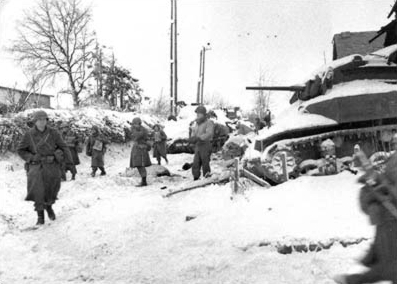
American soldiers of the 117th Infantry Regiment, Tennessee National Guard, part of the 30th Infantry Division, move past a destroyed American M5A1 “Stuart” tank on their march to recapture the town of St. Vith during the Battle of the Bulge, January 1945. [Wikipedia][This piece was originally posted on 16 May 2017.]
This post is a partial response to questions from one of our readers (Stilzkin). On the subject of force ratios in conventional combat….I know of no detailed discussion on the phenomenon published to date. It was clearly addressed by Clausewitz. For example:
At Leuthen Frederick the Great, with about 30,000 men, defeated 80,000 Austrians; at Rossbach he defeated 50,000 allies with 25,000 men. These however are the only examples of victories over an opponent two or even nearly three times as strong. Charles XII at the battle of Narva is not in the same category. The Russian at that time could hardly be considered as Europeans; moreover, we know too little about the main features of that battle. Bonaparte commanded 120,000 men at Dresden against 220,000—not quite half. At Kolin, Frederick the Great’s 30,000 men could not defeat 50,000 Austrians; similarly, victory eluded Bonaparte at the desperate battle of Leipzig, though with his 160,000 men against 280,000, his opponent was far from being twice as strong.
These examples may show that in modern Europe even the most talented general will find it very difficult to defeat an opponent twice his strength. When we observe that the skill of the greatest commanders may be counterbalanced by a two-to-one ratio in the fighting forces, we cannot doubt that superiority in numbers (it does not have to more than double) will suffice to assure victory, however adverse the other circumstances.
and:
If we thus strip the engagement of all the variables arising from its purpose and circumstance, and disregard the fighting value of the troops involved (which is a given quantity), we are left with the bare concept of the engagement, a shapeless battle in which the only distinguishing factors is the number of troops on either side.
These numbers, therefore, will determine victory. It is, of course, evident from the mass of abstractions I have made to reach this point that superiority of numbers in a given engagement is only one of the factors that determines victory. Superior numbers, far from contributing everything, or even a substantial part, to victory, may actually be contributing very little, depending on the circumstances.
But superiority varies in degree. It can be two to one, or three or four to one, and so on; it can obviously reach the point where it is overwhelming.
In this sense superiority of numbers admittedly is the most important factor in the outcome of an engagement, as long as it is great enough to counterbalance all other contributing circumstance. It thus follows that as many troops as possible should be brought into the engagement at the decisive point.
And, in relation to making a combat model:
Numerical superiority was a material factor. It was chosen from all elements that make up victory because, by using combinations of time and space, it could be fitted into a mathematical system of laws. It was thought that all other factors could be ignored if they were assumed to be equal on both sides and thus cancelled one another out. That might have been acceptable as a temporary device for the study of the characteristics of this single factor; but to make the device permanent, to accept superiority of numbers as the one and only rule, and to reduce the whole secret of the art of war to a formula of numerical superiority at a certain time and a certain place was an oversimplification that would not have stood up for a moment against the realities of life.
Force ratios were discussed in various versions of FM 105-5 Maneuver Control, but as far as I can tell, this was not material analytically developed. It was a set of rules, pulled together by a group of anonymous writers for the sake of being able to adjudicate wargames.
The only detailed quantification of force ratios was provided in Numbers, Predictions and War by Trevor Dupuy. Again, these were modeling constructs, not something that was analytically developed (although there was significant background research done and the model was validated multiple times). He then discusses the subject in his book Understanding War, which I consider the most significant book of the 90+ that he wrote or co-authored.
The only analytically based discussion of force ratios that I am aware of (or at least can think of at this moment) is my discussion in my upcoming book War by Numbers: Understanding Conventional Combat. It is the second chapter of the book: https://dupuyinstitute.org/2016/02/17/war-by-numbers-iii/
In this book, I assembled the force ratios required to win a battle based upon a large number of cases from World War II division-level combat. For example (page 18 of the manuscript):
I did this for the ETO, for the battles of Kharkov and Kursk (Eastern Front 1943, divided by when the Germans are attacking and when the Soviets are attacking) and for PTO (Manila and Okinawa 1945).
There is more than can be done on this, and we do have the data assembled to do this, but as always, I have not gotten around to it. This is why I am already considering a War by Numbers II, as I am already thinking about all the subjects I did not cover in sufficient depth in my first book.
For some reason our blog was getting hits from youtube….so I went searching and discovered this newly posted youtube video about General Dynamics proposed “light” tank: https://www.youtube.com/watch?v=1FBtncggpIU
As it says in the remarks (bolding is mine):
Smith’s emphasis upon how lighter-weight armored vehicles can address terrain challenges, and off-road mobility aligns with findings from analytical research performed years ago by the Dupuy Institute.
The research study, call “The Historical Combat Effectiveness of Lighter-Weight Armored Forces,” examined combat scenarios from Vietnam, The Korean War, the Persian Gulf War – and even WWII.
Commissioned by the US Army Center for Army Analysis, the study concluded that heavily armed, yet lighter-weight, more maneuverable armored combat platforms could provided substantial advantage to combat infantry in many scenarios.
“Vehicle weight is sometimes a limited factor in less developed area. In all cases where this was a problem, there was not a corresponding armor threat. As such, in almost all cases, the missions and tasks for a tank can be fulfilled with other light armor,” the study writes.
Drawing upon this conceptual premise, it also stands to reason that a medium-armored vehicles, with heavy firepower, might be able to support greater mobility for advancing infantry while simultaneously engaging in major combat, mechanized force-on-force kinds of engagements where there is armored resistance.
Interesting to discover that this study, that we did in 2001, is being referenced now. It was primarily done by me and Richard Anderson. It was done at the request of Walt Hollis, Deputy Under Secretary of the Army (Operations Research) and CAA was given the task of administering it. CAA seemed uncertain of what to do with it once they received it, but told us around 2002 that their big lesson from the study was that they needed to worry about mine protection for any projected future armor. This was before we went into Iraq.
Anyhow, there were many aspects to this study, which I will not belabor here as you can read it yourself; but it appears that people are cherry picking from parts of it.