Niklas Zetterling’s revised and update version of his excellent book Normandy 1944 is being re-issued. According to Amazon.com it will be available January 10, 2020. The link is here: Normandy 1944
It is set up to “look inside” so you can get some idea what is in there. It is of course, not another war story but a two part discussion on “Campaign Analysis” and “German Combat Formations.”
The “look inside” feature did not include an ability to search the text, so I was not able to check the really important stuff, like how many times Trevor Dupuy and I are mentioned in the book. I am graciously acknowledged in the introduction (as is Richard Anderson). Now, I did write an appendix for the original book. Always the gentleman, Niklas did ask my permission to remove it from this edition.
The book does include a discussion of the relative combat efficiency of the German forces compared to British and U.S. units, always a sensitive subject. We have never invested a lot of time in analyzing Normandy. Most of our analysis of this subject is from Italy 1943-44, Ardennes (Battle of the Bulge) 1944-45 and Kharkov and Kursk 1943 (and shown in War by Numbers). So this is a nice independent look at the subject using additional data from a different campaign by a different scholar.
Various Three-to-one rules of thumbs have existed in the U.S. Army and in writings possibly as early as the American Civil War (1861-1865). These are fine as “rules of thumb” as long as one does not take them seriously and understands what they really mean. But, unfortunately, we have now seen something that is a loose rule of thumb turned into a codified and quantified rule. This is annoyingly overstating its importance and as given in U.S. Army manuals, is patently false.
The U.S. Army has apparently codified the “three-to-one rule” in its documentation and has given it a value. In the 2014 edition of FM 6-0, paragraph 9-103, it states that “For example, historically, defenders have over a 50 percent probability of defeating an attacking force approximately three times their equivalent strength.” This statement, on the surface, simply is incorrect. For example, the following table from my book War by Numbers is drawn from a series of 116 division-level engagements in France in 1944 against the Germans (see War by Numbers, page 10) They show the following relationship between force ratio and outcome:
European Theater of Operations (ETO) Data, 1944
Force Ratio………………..Result…………………Percent Failure…Number of cases
0.55 to 1.01-to-1.00………Attack Fails…………………..100%……………….5
1.15 to 1.88-to-1.00………Attack usually succeeds……21%………………..48
1.95 to 2.56-to-1.00………Attack usually succeeds……10%………………..21
2.71-to-1.00 and higher…Attacker Advances…………….0%……………….. 42
Now these engagements are from fighting between the U.S., UK and Germany in France and Germany in 1944. These are engagements between forces of roughly equal competence. As can be seen, based upon 42 division-level engagements, in all cases of attacks at three-to-one (more specifically 2.71-to-1 and greater), the attacker advanced. Meaning in all cases of attacks at three-to-one, the attacker won. This directly contradicts the statement in FM 6-0, and contradicts it based upon historical data.
This is supplemented by the following two tables on the next page of War by Numbers. The first table shows the German performance when attacking Soviet units in 1943.
Germans attacking Soviets (Battles of Kharkov and Kursk), 1943
Force Ratio………………..Result………………….Percent Failure…Number of cases
0.63 to 1.06-to-1.00………Attack usually succeeds……..20%……………………..5
1.18 to 1.87-to-1.00………Attack usually succeeds……….6%……………………17
1.91-to-1.00 and higher…Attacker Advances……………….0%……………………21
The next table shows the Soviet performance when attacking German units in 1943:
Soviets attacking Germans (Battles of Kharkov and Kursk), 1943
Force Ratio………………Result…………………..Percent Failure…Number of cases
0.40 to 1.05-to-1…………Attack usually fails…………70%……………………10
1.20 to 1.65-to-1.00…….Attack often fails…………….50%……………………11
1.91 to 2.89-to-1.00…….Attack sometimes fails…….44%……………………..9
These charts are from the fighting around Kharkov in February, March and August of 1943 and the fighting during the Battle of Kursk in July 1943. It is 73 engagements between the German and Soviet armies.
Now, there is a clear performance difference between the German and the Soviet armies at this time. This is discussed in considerable depth in War by Numbers and will not be addressed here. But, what it amounts to is that the German Army has an advantage in the casualty exchange and that advantage also shows up in the outcomes of the battles, as show above. If they attacked at two-to-one odds are greater, they would win. The Soviets attacking at the same odds would win only 56 percent of the time. Clearly, at the division-level, in a unit to unit comparison, the Germans were two or three times better than their Soviet opponents.
Still, even in the worse case, which is the Soviets attacking the Germans, we do not get to the claim made in FM 6-0, which is the defender won 50% of the time when attacked at three-to-one. In fact, the Soviets managed to win 50% of the time when attacking at 1.20 to 1.65-to-1. Something is clearly wrong with the statement in FM 6-0.
Now, at the time I wrote War by Numbers, I was not aware of this sentence planted in FM 6-0 and so therefore did not feel a need to respond to the “three-to-one rule.” It is a rule of thumb, not completely without value, that had been discussed before (see Dupuy, Understanding War, pages 31-37). I thought this issue was properly understood in the U.S. analytical and defense community, therefore I did not feel a need to address it further. It turns out that I do. So, I will take a moment to tap into our databases and properly address this using all the resources at my disposal. This will be in subsequent blog posts.
A LCVP from the U.S. Coast Guard-manned USS Samuel Chase disembarks troops of Company E, 16th Infantry, 1st Infantry Division (the Big Red One) at the Fox Green section of Omaha Beach on the morning of 6 June 1944. American soldiers encountered the newly formed German 352nd Division. During the initial landing, two-thirds of Company E became casualties.
Today is the 75th Anniversary of D-Day, the invasion of Normandy by U.S., British, Canadian and other allied forces. The American who announced the D-Day invasion on Tuesday, 6 June 1944 was the journalist, soldier and historian, R. Ernest Dupuy (1887-1975) of New York. The announcement from SHAEF can be heard here (Dupuy’s announcements starts at 2:00): https://www.youtube.com/watch?v=K9xk9GaV0NE
Under the command of General Eisenhower, Allied naval forces, supported by strong air forces, began landing Allied armies this morning on the northern coast of France.
He was the father of Trevor N. Dupuy, the founder of The Dupuy Institute.
Charles MacDonald published in 1985 A Time for Trumpets, one of the better books on the Battle of the Bulge (and there are actually a lot of good works on this battle). In there he recounted a story of why the German Panzer Lehr Panzer Division, commanded by General Fritz Bayerlein, was held up for the better part of a day during the Battle for Bastogne. To quote:
For all Bayerlein’s concern about that armored force, he himself was at the point of directing less than full attention to conduct of the battle. In a wood outside Mageret, his troops had found a platoon from an American field hospital, and among the staff, a “young, blonde, and beautiful” American nurse attracted Bayerlein’s attention. Through much of December 19, he “dallied” with the nurse, who “held him spellbound.” [page 295]
Now, I don’t know if “dallied” means that they were having tea and crumpets, or involved in something more intimate. The story apparently comes from Bayerlein himself, so something probably happened, but exactly what is not known. He was relieved of command after the failed offensive.
Fritz Bayerlein, March 1944 (Source: Bundesarchiv, Bild 146-1978-033-02/Dinstueler/CC-BY-SA 3.0)
When we met with Charles MacDonald in 1989, I did ask him about this story. He then recounted that he was recently at a U.S. veterans gathering talking to some other people, and some lady came up to him and told him that she knew the nurse in the story. MacDonald said he would get back to her….but then could not locate her later. So this was an opportunity to confirm and get more details of the story, but, it was lost (to history). But it does sort of confirm that there is some basis to Bayerlein’s story.
Now, this discussion with MacDonald is from memory, but I believe (the authors) Jay Karamales, Richard Anderson and possibly Curt Johnson were also at that dinner, and they may remember the conversation (differently?).
Anyhow, A Time for Strumpets Trumpets is a book worth reading.
So we created three campaign databases. One of the strangest arguments I have heard against doing validations or testing combat models to historical data, is that this is only one outcome from history. So you don’t know if model is in error or if this was a unusual outcome to the historical event. Someone described it as the N=1 argument. There are lots of reasons why I am not too impressed with this argument that I may enumerate in a later blog post. It certainly might apply to testing the model to just one battle (like the Battle of 73 Easting in 1991), but these are weeks-long campaign databases with hundreds of battles. One can test the model to these hundreds of points in particular in addition to testing it to the overall result.
In the case of the Kursk Data Base (KDB), we have actually gone through the data base and created from it 192 division-level engagements. This covers every single combat action by every single division during the two week offensive around Belgorod. Furthermore, I have listed each and every one of these as an “engagement sheet’ in my book on Kursk. The 192 engagement sheets are a half-page or page-long tabulation of the strengths and losses for each engagement for all units involved. Most sheets cover one day of battle. It took considerable work to assemble these. First one had to figure out who was opposing whom (especially as unit boundaries never match) and then work from there. So, if someone wants to test a model or model combat or do historical analysis, one could simply assemble a database from these 192 engagements. If one wanted more details on the engagements, there are detailed breakdowns of the equipment in the Kursk Data Base and detailed descriptions of the engagements in my Kursk book. My new Prokhorovka book (release date 1 June), which only covers the part of the southern offensive around Prokhorovka from the 9th of July, has 76 of those engagements sheets. Needless to say, these Kursk engagements also make up 192 of the 752 engagements in our DLEDB (Division Level Engagement Data Base). A picture of that database is shown at the top of this post.
So, if you are conducting a validation to the campaign, take a moment and check the results to each division to each day. In the KDB there were 17 divisions on the German side, and 37 rifle divisions and 10 tank and mechanized corps (a division-sized unit) on the Soviet side. The data base covers 15 days of fighting. So….there are around 900 points of daily division level results to check the results to. I drawn your attention to this graph:
There are a number of these charts in Chapter 19 of my book War by Numbers. Also see:
The Ardennes database is even bigger. There was one validation done by CAA (Center for Army Analysis) of its CEM model (Concepts Evaluation Model) using the Ardennes Campaign Simulation Data Bases (ACSDB). They did this as an overall comparison to the campaign. So they tracked the front line trace at the end of the battle, and the total tank losses during the battle, ammunition consumption and other events like that. They got a fairly good result. What they did not do was go into the weeds and compare the results of the engagements. CEM relies on inputs from ATCAL (Attrition Calculator) which are created from COSAGE model runs. So while they tested the overall top-level model, they really did not test ATCAL or COSAGE, the models that feed into it. ATCAL and COSAGE I gather are still in use. In the case of Ardennes you have 36 U.S. and UK divisions and 32 German divisions and brigades over 32 days, so over 2,000 division days of combat. That is a lot of data points to test to.
Now we have not systematically gone through the ACSDB and assembled a record for every single engagement there. There would probably be more than 400 such engagements. We have assembled 57 engagements from the Battle of the Bulge for our division-level database (DLEDB). More could be done.
Finally, during our Battle of Britain Data Base effort, we recommended developing an air combat engagement database of 120 air-to-air engagements from the Battle of Britain. We did examine some additional mission specific data for the British side derived from the “Form F” Combat Reports for the period 8-12 August 1940. This was to demonstrate the viability of developing an engagement database from the dataset. So we wanted to do something similar for the air combat that we had done with division-level combat. An air-to-air engagement database would be very useful if you are developing any air campaign wargame. This unfortunately was never done by us as the project (read: funding) ended.
As it is we actually have three air campaign databases to work from, the Battle of Britain data base, the air component of the Kursk Data Base, and the air component of the Ardennes Campaign Simulation Data Base. There is a lot of material to work from. All it takes it a little time and effort.
I will discuss the division-level data base in more depth in my next post.
There used to be an engagement called “The Amphitheater, 9-11 July 1943′ in our databases. It was in the Land Warfare Data Base (LWDB) and we moved it over to our Division-Level Engagement Data Base (DLEDB). We did revise it. It now consists of two engagements:
Amphitheater Beachhead, 9 September: Created for EPW Study by Richard Anderson on 30 September 1998.
Amphitheater (rev), 10-11 September: Extensively revised 30 October for EPW study by Richard Anderson. Original engagement no. 3940 deleted.
Amphitheater Beachhead:
Engagement No: 23002
Duration: 1 Day
Front Width: 3.5 km
Force Name: Br 56th Infantry Division Ger KG Stempel, 16th PzD
Total Strength: 12,480 5,241
Total Armor: 52 27
Artillery Pieces: 110 36
Total Casualties: 444 142
Armor Losses: 10 3
Artillery Losses: 4 14
Enemy Captured: 54 120
Amphitheater (rev):
Engagement No: 23005
Duration: 2 Days
Front Width: 13 km
Force Name: Br 56th Infantry Division Ger KG Stempel (+), 16th PzD
Total Strength: 12,036 10,271
Total Armor: 42 90
Artillery Pieces: 106 38
Total Casualties: 1,213 478
Armor Losses: 7 44
Artillery Losses: 1 —
Enemy Captured: 23 725
This is response to the discussion under this post:
The DLEDB consists of 752 division-level engagements from 1904 to 1991. There are 121 fields per engagement, including 5 text fields. It is programmed in Access. It is company proprietary.
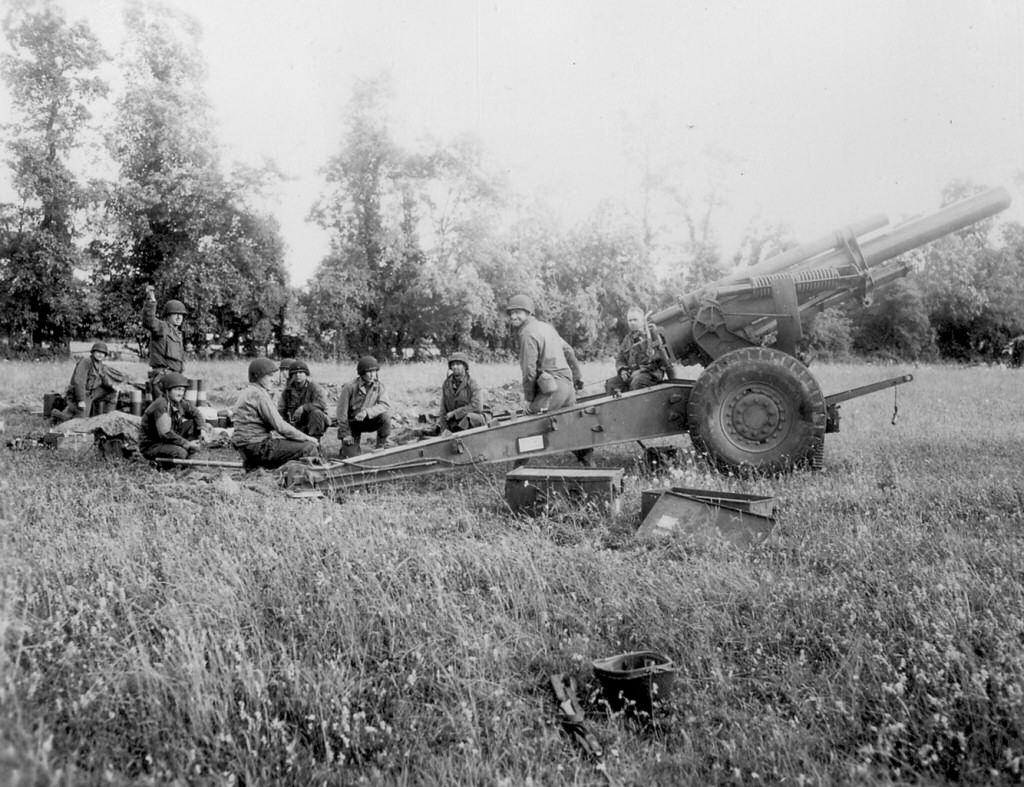
U.S. Army 155mm field howitzer in Normandy. [padresteve.com]
[This series of posts is adapted from the article “Artillery Effectiveness vs. Armor,” by Richard C. Anderson, Jr., originally published in the June 1997 edition of the International TNDM Newsletter.]
Table IX shows the distribution of cause of loss by type or armor vehicle. From the distribution it might be inferred that better protected armored vehicles may be less vulnerable to artillery attack. Nevertheless, the heavily armored vehicles still suffered a minimum loss of 5.6 percent due to artillery. Unfortunately the sample size for heavy tanks was very small, 18 of 980 cases or only 1.8 percent of the total.
The data are limited at this time to the seven cases.[6] Further research is necessary to expand the data sample so as to permit proper statistical analysis of the effectiveness of artillery versus tanks.
NOTES
[18] Heavy armor includes the KV-1, KV-2, Tiger, and Tiger II.
[19] Medium armor includes the T-34, Grant, Panther, and Panzer IV.
[20] Light armor includes the T-60, T-70. Stuart, armored cars, and armored personnel carriers.
Knocked-out Panthers in Krinkelt, Belgium, Battle of the Bulge, 17 December 1944. [worldwarphotos.info]
[This series of posts is adapted from the article “Artillery Effectiveness vs. Armor,” by Richard C. Anderson, Jr., originally published in the June 1997 edition of the International TNDM Newsletter.]
[14] From ORS Joint Report No. 1. A total of an estimated 300 German armor vehicles were found following the battle.
[15] Data from 38th Infantry After Action Report (including “Sketch showing enemy vehicles destroyed by 38th Inf Regt. and attached units 17-20 Dec. 1944″), from 12th SS PzD strength report dated 8 December 1944, and from strengths indicated on the OKW briefing maps for 17 December (1st [circa 0600 hours], 2d [circa 1200 hours], and 3d [circa 1800 hours] situation), 18 December (1st and 2d situation), 19 December (2d situation), 20 December (3d situation), and 21 December (2d and 3d situation).
[16] Losses include confirmed and probable losses.
[17] Data from Combat Interview “26th Infantry Regiment at Dom Bütgenbach” and from 12th SS PzD, ibid.
The U.S. Army 333rd Field Artillery Battalion (Colored) in Normandy, July 1944 (US Army Photo/Tom Gregg)
[This series of posts is adapted from the article “Artillery Effectiveness vs. Armor,” by Richard C. Anderson, Jr., originally published in the June 1997 edition of the International TNDM Newsletter.]
[11] Five of the 13 counted as unknown were penetrated by both armor piercing shot and by infantry hollow charge weapons. There was no evidence to indicate which was the original cause of the loss.
[12] From ORS Report No. 17
[13] From ORS Report No. 15. The “Pocket” was the area west of the line Falaise-Argentan and east of the line Vassy-Gets-Domfront in Normandy that was the site in August 1944 of the beginning of the German retreat from France. The German forces were being enveloped from the north and south by Allied ground forces and were under constant, heavy air attack.
A U.S. M1 155mm towed artillery piece being set up for firing during the Battle of the Bulge, December 1944.
[This series of posts is adapted from the article “Artillery Effectiveness vs. Armor,” by Richard C. Anderson, Jr., originally published in the June 1997 edition of the International TNDM Newsletter.]
The effectiveness of artillery against exposed personnel and other “soft” targets has long been accepted. Fragments and blast are deadly to those unfortunate enough to not be under cover. What has also long been accepted is the relative—if not total—immunity of armored vehicles when exposed to shell fire. In a recent memorandum, the United States Army Armor School disputed the results of tests of artillery versus tanks by stating, “…the Armor School nonconcurred with the Artillery School regarding the suppressive effects of artillery…the M-1 main battle tank cannot be destroyed by artillery…”
This statement may in fact be true,[1] if the advancement of armored vehicle design has greatly exceeded the advancement of artillery weapon design in the last fifty years. [Original emphasis] However, if the statement is not true, then recent research by TDI[2] into the effectiveness of artillery shell fire versus tanks in World War II may be illuminating.
The TDI search found that an average of 12.8 percent of tank and other armored vehicle losses[3] were due to artillery fire in seven eases in World War II where the cause of loss could be reliably identified. The highest percent loss due to artillery was found to be 14.8 percent in the case of the Soviet 1st Tank Army at Kursk (Table II). The lowest percent loss due to artillery was found to be 5.9 percent in the case of Dom Bütgenbach (Table VIII).
The seven cases are split almost evenly between those that show armor losses to a defender and those that show losses to an attacker. The first four cases (Kursk, Normandy l. Normandy ll, and the “Pocket“) are engagements in which the side for which armor losses were recorded was on the defensive. The last three cases (Ardennes, Krinkelt. and Dom Bütgenbach) are engagements in which the side for which armor losses were recorded was on the offensive.
Four of the seven eases (Normandy I, Normandy ll, the “Pocket,” and Ardennes) represent data collected by operations research personnel utilizing rigid criteria for the identification of the cause of loss. Specific causes of loss were only given when the primary destructive agent could be clearly identified. The other three cases (Kursk, Krinkelt, and Dom Bütgenbach) are based upon combat reports that—of necessity—represent less precise data collection efforts.
However, the similarity in results remains striking. The largest identifiable cause of tank loss found in the data was, predictably, high-velocity armor piercing (AP) antitank rounds. AP rounds were found to be the cause of 68.7 percent of all losses. Artillery was second, responsible for 12.8 percent of all losses. Air attack as a cause was third, accounting for 7.4 percent of the total lost. Unknown causes, which included losses due to hits from multiple weapon types as well as unidentified weapons, inflicted 6.3% of the losses and ranked fourth. Other causes, which included infantry antitank weapons and mines, were responsible for 4.8% of the losses and ranked fifth.
NOTES
[1] The statement may be true, although it has an “unsinkable Titanic,” ring to it. It is much more likely that this statement is a hypothesis, rather than a truism.
[2] As pan of this article a survey of the Research Analysis Corporation’s publications list was made in an attempt to locate data from previous operations research on the subject. A single reference to the study of tank losses was found. Group 1 Alvin D. Coox and L. Van Loan Naisawald, Survey of Allied Tank Casualties in World War II, CONFIDENTIAL ORO Report T-117, 1 March 1951.
[3] The percentage loss by cause excludes vehicles lost due to mechanical breakdown or abandonment. lf these were included, they would account for 29.2 percent of the total lost. However, 271 of the 404 (67.1%) abandoned were lost in just two of the cases. These two cases (Normandy ll and the Falaise Pocket) cover the period in the Normandy Campaign when the Allies broke through the German defenses and began the pursuit across France.