We used some of these, designated at the T-10 in the Korean War (1950-1953). We even had a 13,000 pound guided bomb version of it that was used in Korea: https://en.wikipedia.org/wiki/ASM-A-1_Tarzon
Now re-designated as the M-121, this 10,000 pound version of the bomb was used pretty extensively in Vietnam, usually air dropped by helicopters to create landing zones, often in a “hot” area: https://en.wikipedia.org/wiki/M-121_(bomb)
Anyhow, these weapons have been around for a while, but I think this is the first use of one in combat since Vietnam (please correct me if I am wrong).
Map from “Cartographies of Time” courtesy of Princeton Architectural Press.
We at the The Dupuy Institute love infoporn, those amazing, information-laden graphics that at once render dense, complex topics instantly understandable to the masses. Wired,Jalopnik, and Gizmodohave tags dedicated to sharing the best examples of it. Wiktionary defines infoporn as “Information which does not serve a purpose other than to hold the attention of its audience; information for information’s sake.” Perhaps so, but we at TDI feel that beauty is in the eye of the beholder.
Betsey Mason, a co-author of National Geographic‘s All Over The Map blog, has a profile of one of the greatest purveyors of infoporn, Charles Minard. Minard created what is considered by many to be the iconic work of information graphics, “Napoleon’s March,” or “the Minard graphic.” Created in 1869, Minard’s map depicts Imperial France’s doomed 1812-13 invasion of Russia. It traces the advance and catastrophic retreat of Napoleon Bonaparte’s Grande Armee, while simultaneously showing its gradually dwindling manpower. At age 88, Minard conveyed an essential understanding of the subject with an imaginative combination of spacial and quantitative information that continues to resonate and astonish nearly a century and a half later.
As Mason writes,
Today Minard is revered in the data-visualization world, commonly mentioned alongside other greats such as John Snow, Florence Nightingale, and William Playfair. But Minard’s legacy has been almost completely dominated by his best-known work. In fact, it may be more accurate to say that Napoleon’s March is his only widely known work. Many fans of the March have likely never even seen the graphic that Minard originally paired it with: a visualization of Hannibal’s famous military campaign in 218 BC, as seen in the image [above].
Go check out the full article and marvel at the power of infoporn.
Well, it looks like the National Security Council has been re-structured in the first three months of the administration, with the original head Flynn replaced by H.R. McMaster, Steve Bannon removed from it, the Chairmen of the JCS and Director of National Intelligence invited back, and Deputy National Security Advisor K.T. McFarland “promoted” to ambassador to Singapore. Dina Powell remains as the Deputy National Security Advisor for Strategy. This is a wholesale change in the first three months of the administration. It is still lacking the traditional highly experienced foreign policy scholar or professional in the mode of a Kissinger, Brzezinski, or Scowcroft. McMaster’s reputation was as a combat commander, not a foreign policy expert.
West Point class of 1986. Platoon and Company commander, then went to medical school becoming a doctor. Was a flight surgeon in special operations. Served in Iraq and Afghanistan. Was the doctor who first sat with and interviewed Saddam Hussein when he was captured. Wrote a book about it: night-saddam-Mark-Green-md
Left service in 2006 after 20 years. Founded a medical company. Elected to the Tennessee Senate in 2012.
Four F-35B Lightning II aircraft perform a flyover above the amphibious assault ship USS America (LHA 6) during the Lightning Carrier Proof of Concept Demonstration. [US Navy photo by Andy Wolfe]
The US Marine Corps (USMC) is practicing some new concepts of operation (CONOPS), using their new F-35B aircraft. The combination of a stealthy, Short-Take-Off-Vetical-Landing (STOVL) fighter with great sensors, with the aviation-centric configuration of the America Class vessels; the “Lightening Carrier (CV-L)” concept, and the flexible basing options from their CONOPS have some great potential to rapidly extend the power of the USMC ashore. “After fifteen years of emphasizing sustained operations ashore, the Marine Corps is refocusing on its naval and expeditionary roots and full-spectrum operations across the range of military operations (ROMO).” (2017 Marine Aviation Plan)
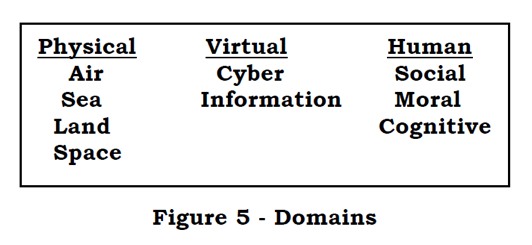
The 21st century Marine Air Ground Task Force (MAGTF) conducts maneuver warfare in the physical and cognitive dimensions of conflict to generate and exploit psychological, technological, temporal, and spatial advantages over the adversary. The 21st century MAGTF executes maneuver warfare through a combined arms approach that embraces information warfare as indispensable for achieving complementary effects across five domains – air, land, sea, space, and cyberspace. The 21st century MAGTF avoids linear, sequential, and phased approaches to operations and blends maneuver warfare and combined arms to generate the combat power needed for simultaneity of action in its full range of missions. The 21st century MAGTF operates and fights at sea, from the sea, and ashore as an integrated part of the naval force and the larger combined/joint force. (emphasis added) (ibid)
The concepts laid out in the USMC document are:
Distributed Aviation Operations (DAO) – this is a plan to reduce predictability and operate from austere locations, “independent of specialized fixed infrastructure”
Distributed STOVL Operations (DSO) – similar to DSO, but with “[F]uel and ordnance resupply conducted at mobile forward arming and refueling points (M-FARPS) located closer or within the operating area.”
“Complementing…is the mobile distribution site (MDS) concept, a vehicle-mobile site located away from the M-FARP, intended to re-arm and re-fuel the M-FARP while maintaining an element of deception and decoy. DSO is sustainable using surface connectors, land-based MDSs and host nation support, enabling readiness and sortie generation for the MAGTF.”
We might never need to employ this way…but to not lean forward to develop this capability, to train and exercise with it, is to deny ourselves a force multiplier that highlights the agility and opportunity only the Navy-Marine Corps team can provide. (ibid)
How Do These USMC Lightening Carriers Compare?
The America Class amphibious assault ship, which at ~45,000 ton displacement is larger that the French nuclear carrier Charles De Gaulle (~42,000 tons), and approaching the size of the Russian and Chinese Kuznetsov class carriers (~55,000 tons), about the same size as the Indian modified Kiev class carrier (~45,000 tons), and bigger than the Japanese Izumo Class “helicopter destroyer” (~27,000 tons), which to a layman’s eyes is an aircraft carrier; even though these vessels operate only helicopters today, the capability to operate F-35B aircraft in the future is certainly exists. Of course the dominant carrier force is the US Navy’s Nimitz class, and newer Ford class (~100,000 tons), which operate aircraft using Catapult-Assisted-Take-Off-But-Arrested-Recovery (CATOBAR). Interestingly, the British initially designed their Queen Elizabeth class carriers (~70,000 tons) to be CATOBAR, which gives the advantage of being able to launch heavier fighters (i.e. more weapons and fuel). A doubling of the estimated cost for CATOBAR forced a redesign back to a STOVL design back in 2012.
Are STOVL Aircraft Inherently Inferior?
This is an excellent question. The physical laws of nature have a vote here, because a STOVL aircraft must carry a smaller payload, than a CATOBAR aircraft, since it lacks the initial thrust provided by the catapult. David Axe of War is Boring has delivered a scathing account of the STOVL concept and history, (to again target the F-35). The USMC pursued STOVL technology, in spite of ” …crash-plagued experimentation throughout the early years of the jet age — every STOVL or V/STOL prototype from 1946 to 1966 crashed. “USMC interest in a working V/STOL attack aircraft outstripped the state of aeronautical technology.”
The British, meanwhile, concerned about Russian bomber and missile attacks on their airfields during the Cold War, developed the Harrier Jump Jet, which did not require a lengthy, fixed runway.
But the Harrier, so appealing in theory, has been a disaster in practice … In the 1991 Gulf War, the front-line concrete lily pads never showed up, so the jump jet had to fly from distant full-size bases or assault ships. With their very limited fuel, they were lucky to be able to put in five or 10 minutes supporting Marines on the ground — and they proved tremendously vulnerable to machine guns and shoulder-fired missiles.
Indeed, Mr. Axe quotes the infamous Pierre Sprey – “The Harrier was based on a complete lie.” (emphasis added).
Harrier jump-jets performed well beyond the performance expectations of most military experts. The remarkable record of the aircraft is attributed not only to relatively sophisticated gadgetry, such as warning receivers and electronic countermeasures to confuse Argentine antiaircraft weapons, but also to the skilled British pilots…and the older Argentine planes…. In spite of its spectacular successes against British ships, Argentina lost the air-to-air war decisively. Argentine fighter aircraft failed to shoot down a single Harrier. British Harrier losses totaled nine–four to accidents and five by surface-based air defenses–surface-to-air missiles (SAMs) and antiaircraft artillery (AAA).
The USMC concepts specifically called out the ability to exploit spatial advantages, which also played a key roll in the Falklands:
The 400 miles from Argentina to the islands partially explained why the score was so lopsided. To make the 800-mile round trip from the Rio Gallegos Air Base on the coast severely strained the maximum operating range of the Argentine aircraft. Consequently, Argentine pilots had all they could do to reach the conflict area undetected and deliver their ordnance, “getting in and getting out” as quickly as possible.” (Ibid)
This geo-spatial situation is reminiscent of the Battle of Britain, where the RAF operated fighter aircraft nearby the battle location, while the Luftwaffe operated at the edge of their range, a limitation which was also widely credited as an important factor in the outcome.
[T]he Royal Navy was forced to go to war with only two short vertical takeoff and landing (STOVL) ships and their STOVL aircraft, the Harrier…. [T]hese units performed very well. It has been stated that had the British not had aircraft with the capabilities of the Harrier (STOVL, high reliability, and high availability) and the two small ships to operate them, it is unlikely the United Kingdom would have committed itself to hostilities in the South Atlantic…. Perhaps its greatest feature was surprising flexibility…. One of the best features of the Harrier was versatility in operating from a variety of platforms under actual combat conditions.
It is precisely this flexibility that STOVL aircraft—both the F-35B and the Harrier before it—which is leveraged in the USMC concepts. The F-35B has the added advantage that one of its key capabilities is the delivery of timely, accurate information. This information is delivered across the battle network at the speed of light, and weighs nothing, so the STOVL limitations do not apply in the same way. It seems clear that any evaluation of the F-35B’s capabilities need to consider these advantages, rather than focusing exclusively on metrics related to the Energy-Maneuverability Theory, such as wing loading, thrust to weight ratio.
On the front page, the site links to an article written in 1981 by General Donn A. Starry, one of the prime movers behind the development of the Army’s AirLand Battle doctrine. His notion of the “extended battlefield” remains as relevant today as when he first addressed it.
I’ve been reviewing the U.S. armed forces vision for how to fight and win with the F-35. It plays a pretty central role in each services’ vision documents, meaning that they have all adapted to the “top-down” strategic guidance given by the Department of Defense (DOD). But the interesting part is the differences between the services’ documents and statements.
How The Services View Their F-35s
Below are the U.S. armed forces I’ve focused on, and their current and future plans for the F-35. The table is from the FlightGlobal World Air Forces 2017 report.
Given the large numbers of aircraft going to training units, we can see that all forces are building their new pilot numbers, and according to Lt Col Berke (via an Aviation Week interview), they will put new pilots into F-35s, so they simply learn a fifth generation mindset from scratch, rather than having to “un-learn” the fourth generation mindset.
Another viewpoint exists on the U.S. military force posture in Asia that is essentially militaristic. The map image above is from a Forbes article, calling other US media “blind to the militarism of its own mentality and approach, as well as to the essential militarism of the U.S. alliance system in Asia, with its “cornerstone” of U.S. bases, including the headquarters and the Seventh Fleet, and some 100,000 force personnel in Japan and South Korea.” The Marine Corps is apparently quite keen to replace their ageing AV-8B and early model F/A-18A/B/C/D aircraft (as they have skipped out on the Super Hornet F/A-18E/F).
Meanwhile the U.S. Navy has articulated their vision in a document from Naval Air Systems Command (NAVAIR) entitled Naval Aviation Vision 2016-2025. They state:
The supersonic, multi-role, multi-service F-35 Lightning II represents a quantum leap in air superiority capability. Combining the next-generation fighter characteristics of radar-evading stealth, supersonic speed and fighter agility with the most powerful and comprehensive integrated sensor package of any fighter aircraft in history, the F-35 delivers unprecedented lethality and survivability to Naval Aviation [emphasis added].
Their characterization of the F-35 as an instrument of air superiority is perhaps a bit too optimistic, or stretches the F-35 capability a bit too much. In an assessment from the U.S. Naval War College of “Chinese Air Superiority in the Near Seas”, the F-35 does not stand out from the pack of Chinese and American fourth generation fighters, in the same way that the F-22 clearly does:
Dealing with the Joint Strike Fighter, Hostage says he is ‘going to fight to the death to protect the F-35’ since the only way to keep up with the adversaries, which ‘are building fleets that will overmatch our legacy fleet’, is by employing a sufficient fleet of 1,763 (‘not one less’) F-35s. You can update and upgrade the F-15 and F-16 fleets, but they would still become obsolete in the next decade. But, the F-22 Raptor will have to support the F-35. And here comes another problem. When the Raptor was produced it was flying ‘with computers that were already so out of date you would not find them in a kid’s game console in somebody’s home gaming system.’ Still, the U.S. Air Force was forced to use the stealth fighter plane as it was, because that was the way the spec was written. But now, the F-22 must be upgraded through a costly service life extension plan and modernization program because, ‘If I do not keep that F-22 fleet viable, the F-35 fleet frankly will be irrelevant. The F-35 is not built as an air superiority platform. It needs the F-22,” says Hostage to Air Force Times.’ [emphasis added].
F-22 + F-35 = Air Superiority
[Source: 5th Generation Fighters, Lt Gen Hawk Carlisle, USAF ACC]
[E]xamine [the] Raptor versus the Lightning. A Raptor at 50-plus thousand feet at Mach 2 with its RCS has a different level of invulnerability than a Lightning at 35,000 at Mach .9 and it’s RCS. The altitude, speed, and stealth combined in the two platforms, they give the airplanes two completely different levels of capability. The plan is to normalize the Lightning’s capability relative to the Raptor by marrying it up with six, or seven or eight other Lightening’s. The advanced fusion of the F-35 versus the F-22 means those airplanes have an equal level or better level of invulnerability than the Raptors have, but it takes multiple airplanes to do it because of the synergistic fused attacks of their weapon systems. That’s the magic of the fifth-gen F-35, but it takes numbers of F-35s to get that effect. That’s why I’ve been so strident on getting the full buy. Because if they whittle it down to a little tiny fleet like the Raptor, it’s not going to be compelling.
[T]he F-22 was a key enabler for the air combat force currently, and had led to a re-norming of airpower in practice … It’s not just that the F-22s are so good, it’s that they make every other plane better. They change the dynamic with respect to what the other airplanes are able to do because of what they can do with regard to speed, range, and flexibility. It’s their stealth quality. It’s their sensor fusion. It’s their deep penetration capability. It is the situational awareness they provide for the entire fleet which raises the level of the entire combat fleet to make everybody better. The F-22s make the Eagles better, and the A-10s better, and the F-16s better. They make the bombers better. They provide information. They enable the entire fight. And its information dominance, its sensor fusion capability, it’s a situational awareness that they can provide to the entire package which raises the level of our capabilities in the entire fight. This is not about some distant future; it is about the current fight.
General Carlisle also announced that “[t]he exercise coming up at Langley in December 2015 will feature the F-22 flying with the Typhoon (XI Squadron from the RAF) and the Rafales from the French Air Force. What these three aircraft have in come is that they all are about 10 years old in terms of combat experience and life.”
Perhaps these exercises were engineered to test improvements to the F-22’s combat capabilities, especially Within-Visual-Range (WVR), aptly named since the Mark 1 human eyeball becomes a sensor that stealth cannot fool. In May of 2015, the Raptor fired its first AIM-9X sidewinder, latest generation dogfight missiles. Along with a helmet-mounted sight, this capability was fielded by the Soviet Union in 1984, when the R-73 (AA-11 “Archer”) was mated to the MiG-29 Fulcrum. According to Lt. Col. Fred “Spanky” Clifton, who is one of the most experienced aggressor pilots ever, having flown the F-15, F-5, F-16 and the notorious MiG-29, “[i]n the WVR (within visual range) arena, a skilled MiG-29 pilot can give and Eagle or Viper driver all he/she wants.”
The experience at Red Flag Alaska in 2012, a training exercise which saw the F-22 go up against Typhoons of the German Luftwaffe, was perhaps humbling for the Air Force to some degree, as the German pilots reported they had “Raptor salad for lunch,” and subsequently painted F-22 kills on their aircraft. This may have provided some impetus to deploy better capabilities; this year, Raptor pilots were happy to see the incremental update 3.2, which fielded the AIM-9X capability.
The 9X Block 1 version of the dual-use, infrared missile is “a dramatic leap within visual range missile capabilities,” said Lt. Col. Daniel, an F-22 pilot of the 95th Fighter Squadron at Tyndall Air Force Base in Florida. … with the AIM-9M ‘Mike’ we kind of went out there going, ‘We have six missiles,” Daniel joked, referring to the increased effort required to make the weapon effective in modern combat operations. ‘With AIM-9X, we step out the door going, ‘We got eight missiles on the jet.’
This seems clear, the F-22 dominates the fight from Beyond Visual Range (BVR), where its stealth and radar provide it the initiative and the ability to use the element of surprise in its favor. An analysis by Aviation Week, using publicly available data from system manufacturers, illustrates this quantitatively and graphically.
Large ‘fourth-generation’ fighters such as the F-15, Su-27 and Tornado have radar cross-sections (RCS) of 10-15 m2. The F-16 and “Gen-4.5” fighters—Typhoon, Rafale, Su-35 and Super Hornet—are believed to be in the 1-3-m2 range. The F-35 and F-22 RCSs are said to equal a golf ball and marble, respectively. Based on Sukhoi’s claims that its Su-35 can detect 3-m2 targets at 400 km in a narrow-angle, maximum-power search, Aviation Week estimated how far away it can detect these fighters. Note the detection range in a standard search is half as much. [Credit: Colin Throm/AW&ST]Almaz-Antey says the S-400’s 92N6E “Gravestone” fire-control radar can detect a 4-m2 radar-cross-section target at 250 km. Based on this figure, Aviation Week estimated its detection range against modern fighter aircraft. [Credit: Colin Throm/AW&ST]
The F-35 should be able to use these same tactics, as it has those capabilities as well. Once the fight devolves into WVR, even the Raptor, designed as an air superiority platform, finds challenges with capable fourth generation opponents. Should we expect the F-35 to fare better or worse than the F-22 in the same situation?
It seems this is one of the key questions in air-to-air combat modeling or war-gaming: how often are engagements taking place at BVR, and how often are they WVR? This is all the more challenging since “visual range” is a highly dynamic and situational.
A combined Ukrainian Army and police operation in May and June had achieved considerable success against the Separatist forces and the government of Ukrainian President Petro Poroshenko had declared a unilateral cease-fire in late June. Ukrainian forces resumed the offensive at the beginning of July and fighting broke out around the Luhansk International Airport on 9 July
Zelenopillya, Ukraine and surrounding area [Google Maps]
At about 0430 on the morning of 11 July, a column of battalions from the Ukrainian 24th and 72nd Mechanized Brigades and 79th Airmobile Brigade was struck with an intense artillery barrage near Zelenopillya. The attack lasted only three minutes or so, but imagery posted online of the alleged aftermath reported a scene of devastation and scores of burned out vehicles (see below). Ukraine’s Defense Ministry admitted to 19 killed and 93 wounded in the attack, though other sources claimed up to 36 fatalities. No figures were released on the number of vehicles lost, but a survivor reported on social media that a battalion of the 79th Airmobile Brigade had been almost entirely destroyed.
Video of the aftermath of the attack on Zelenopillya. [LiveLeak]
Video of Russian MLRSs allegedly firing from the same location as the 11 July 2014 strike on Zelenopillya. [YouTube]
Western military analysts took notice of the Zelenopillya attack and similar strikes on Ukrainian forces through the summer of 2014. What caught their attention was the use of drones by the Separatists and their Russian enablers to target Ukrainian forces in near-real time. The Ukrainians had spotted Separatist drones as early as May, but their number and sophistication increased significantly in July, as Russian-made models were also identified.
The sophistication and effectiveness of the attack, in combination with other technological advances in Russian armaments, and new tactics demonstrated in the conflict with Ukraine, prompted the U.S. Army Capabilities Integration Center, then led by Lieutenant General H.R. McMaster, to initiate the Russian New Generation Warfare Study to look at how these advances might influence future warfare. The advent of new long-range precision strike capabilities, high-quality air defense systems, maritime anti-access weapons, information operations and cyber warfare, combined with the adoption of anti-access/area denial (A2/AD) strategies by potential adversaries led into the technologically-rooted Third Offset Strategy and development of the Army and U.S. Marine Corps’ new Multi-Domain Battle concepts.
Probably doesn’t mean much but 7,000 protestors is a pretty big protest by Russian standards. Still, it appears that the authorities were concerned enough that they put it down quickly with hundreds of arrests (500?). There were times when they were less concerned about opposition. Next presidential election is in 2018.